Which Type of incremental encoders Is Easier to Maintain?
Choosing the right encoder for an industrial automation system can feel like navigating a maze — so many options, each promising precision and efficiency. Among these, incremental encoders often stand out thanks to their reliability and cost-effectiveness. Yet, when maintenance and long-term upkeep enter the picture, the question becomes: which encoder is actually easier to maintain — incremental or absolute?
Let’s break it down in a friendly, engineer-to-engineer way and help you make the right choice for your line, machine, or robotic setup.
Understanding the Basics What Are Incremental Encoders
At their core, incremental encoders are motion feedback devices that generate pulses as a shaft rotates. Each pulse represents a small “increment” of movement, allowing controllers or PLCs to measure speed, direction, and position changes.
Incremental encoders are widely used in motion control systems, servo applications, and industrial automation, mainly because they offer:
- High resolution at a lower cost compared to absolute encoders.
- Simple integration with existing systems.
- Real-time feedback for dynamic motion measurement.
They’re like the reliable odometers of the automation world — measuring movement with consistency and accuracy.
| Encoder Type | Signal Output | Position Reference | Typical Use Case |
|---|---|---|---|
| Incremental Encoder | Pulse signal (A, B, Z channels) | Lost after power-off | Motors, conveyors, packaging machines |
| Absolute Encoder | Digital word per position | Retained after power-off | Robotics, elevators, CNC machines |
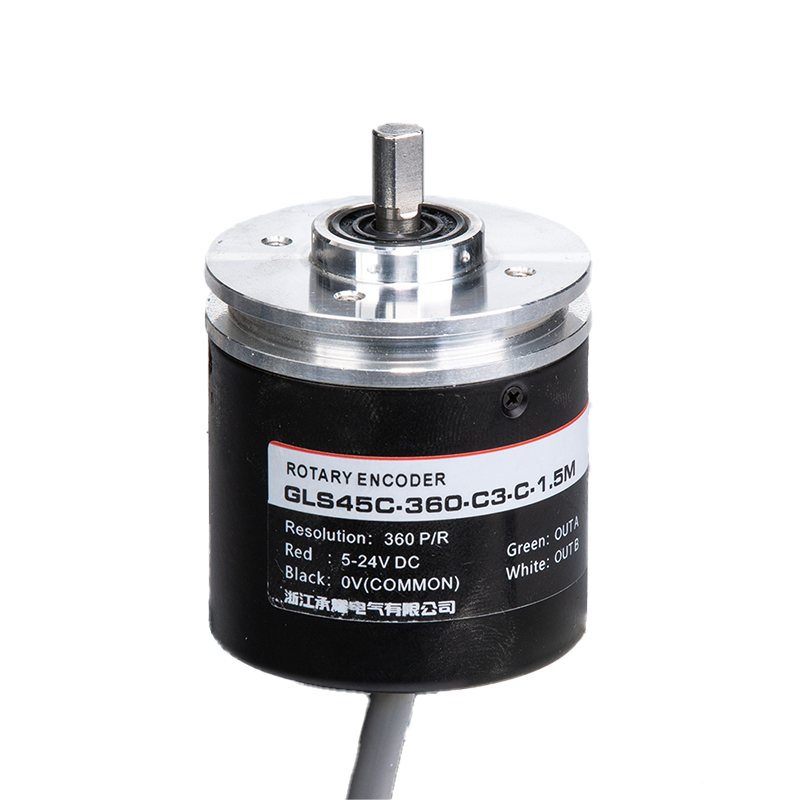
Incremental vs. Absolute Encoders Maintenance and Practicality
When it comes to maintenance, simplicity is often the winning factor. Incremental encoders score highly in this regard. They have fewer internal components, easier wiring setups, and are surprisingly forgiving in harsh operating environments.
In contrast, absolute encoders — although more advanced — rely on complex multi-turn electronics and memory chips that require careful calibration. The result? If an issue occurs, downtime tends to last longer and repairs are more specialized.
Imagine your production line halting due to an encoder fault. With an incremental encoder, a technician can usually replace it, recalibrate zero, and you’re back up and running within minutes. But with an absolute encoder? You might need a specialist with proprietary software to reprogram it.
| Maintenance Aspect | Incremental Encoder | Absolute Encoder |
|---|---|---|
| Calibration | Quick, manual reset | Software-based setup |
| Complexity | Low | High |
| Spare Part Availability | Widely available | Often brand-specific |
| Typical Repair Time | 10–20 minutes | 1–2 hours |
| Cost of Maintenance | Low | Moderate to high |
Key Advantages of Incremental Encoders in Long-Term Operation
Incremental encoders are ideal for teams prioritizing ease of maintenance, especially in high-uptime industries like manufacturing, logistics, and robotics. Here’s why many B2B clients prefer them:
- Simpler Diagnostics. When an issue arises, technicians can quickly check pulse signals and determine if the issue is mechanical or electronic.
- Lower Inventory Cost. They’re modular and easily replaceable, so keeping spare units isn’t a financial burden.
- Compatibility Across Systems. Whether using Siemens, Mitsubishi, or Beckhoff PLCs, incremental encoders often integrate seamlessly.
- Minimal Downtime. Quick reinstallation means production doesn’t stay idle for long.
- Durable Design. Many models offer high IP ratings, operating temperatures from –20°C to +100°C, and shock resistance for harsh environments.
Common Maintenance Scenarios and How to Handle Them
Even the best encoders sometimes need attention. Here are some maintenance examples engineers often face — and how incremental encoders make it simpler:
- Shaft Misalignment: Loosen the coupling, realign, and tighten — no complex recalibration needed.
- Signal Dropouts: Check cable continuity and connector integrity; replacing a broken cable often restores function.
- Contamination or Dust Exposure: With sealed housings (IP65+), incremental encoders can easily be cleaned without affecting calibration.
- Vibration Damage: Robust mounting brackets help absorb shocks without degrading performance.
In short, maintenance becomes predictable, repeatable, and fast — three words every production engineer loves.
Choosing Based on Your Application
Not every system benefits equally from incremental encoders. If your equipment loses its reference position during power cycles or if you need exact absolute positioning (like in elevators or robotics arms), an absolute encoder may still be required.
However, for high-speed applications such as conveyor systems, textile machines, or CNC spindles, incremental encoders provide the right balance of performance and maintainability.
| Application | Recommended Encoder | Why |
|---|---|---|
| Servo motor speed control | Incremental | Quick response and simple feedback |
| Robotic arms (multi-axis) | Absolute | Needs position memory |
| Conveyor & packaging | Incremental | Low cost and easy maintenance |
| Elevator cabin control | Absolute | Safety-critical positioning |
| 3D printing | Incremental | Easy calibration and rehoming |
Safety, Calibration, and Modern Upgrades
Modern incremental encoders now integrate diagnostic LEDs, auto-calibration, and even digital communication interfaces like RS-422, HTL, and TTL outputs. These upgrades bridge the gap between incremental and absolute models, offering better maintainability while staying affordable.
Some manufacturers offer field-programmable encoders — meaning you can reconfigure resolution, direction, and zero-reference using a service interface without replacing hardware.
This not only minimizes downtime but also reduces operational costs for large-scale facilities.
Environmental Considerations and Durability
When assessing “ease of maintenance,” don’t overlook environmental factors. Incremental encoders often feature:
- Stainless steel housings for chemical or marine environments.
- Magnetic sensing technology resistant to dust and oil.
- Compact designs for limited-space installations.
Absolute encoders can be sensitive to electromagnetic interference or require delicate optical disks. Incremental encoders, by contrast, are rugged and forgiving, performing reliably in challenging conditions such as cement plants or paper mills.
| Feature | Incremental Encoder | Absolute Encoder |
|---|---|---|
| Resistance to Dust/Oil | High | Moderate |
| Magnetic Interference Tolerance | Excellent | Sensitive |
| Field-Calibratable | Yes | Limited |
| Working Life Expectancy | 5–10 years | 4–8 years |
So, which type of encoder is easier to maintain?
Without question, incremental encoders win in most B2B applications. They combine simplicity, durability, and fast servicing — three pillars of efficient factory maintenance.
For factories aiming to minimize downtime and reduce total cost of ownership, incremental encoders remain the most practical choice. Whether you are an OEM, system integrator, or maintenance engineer, choosing the right encoder can make your automation system more reliable than ever.
Ready to explore cost-effective incremental encoder options? Contact our sales team or request a free technical consultation — we’ll help you find the ideal match for your application.
FAQ
u003cstrongu003eHow often should I clean or inspect an incremental encoder?u003c/strongu003e
Typically once every 6–12 months, depending on dust levels and environmental exposure.
u003cstrongu003eCan I replace an incremental encoder without reprogramming the system?u003c/strongu003e
Yes. In most cases, a quick zero-point reset or simple wiring is enough.
u003cstrongu003eAre incremental encoders suitable for harsh outdoor environments?u003c/strongu003e
Absolutely. Models with IP67-rated housings perform reliably even in wet or dusty conditions.
u003cstrongu003eWhat’s the average lifespan of an incremental encoder?u003c/strongu003e
Typically between 5 and 10 years, assuming proper alignment and electrical protection.
u003cstrongu003eIs it possible to upgrade to a programmable incremental encoder for flexibility?u003c/strongu003e
Yes. Modern designs allow reconfiguration via USB or fieldbus interfaces.