Incremental Linear Encoder High Precision Sensors for Automation
How Incremental Linear Encoders Work
Incremental linear encoders are precision linear position sensors that provide relative position feedback by generating electrical pulses as a readhead moves along a scale. The core operating principle revolves around pulse generation from the interaction between the readhead (or sensor) and the linear scale, which can be made of materials like glass, steel tape, magnetic strips, or even PCB-based tracks.
Key Components
- Readhead/Sensor: Detects scale patterns and converts movement into electrical signals.
- Scale: A finely patterned linear track—common types include:
- Glass scales with etched lines (optical)
- Steel tape scales (magnetic or optical)
- Magnetic strips or coded PCB tracks
Signal Types
Incremental linear encoders output several kinds of signals:
- Quadrature A/B signals: Two pulse trains shifted by 90° to determine movement direction and count pulses accurately.
- Index pulse (Z channel): A single pulse per revolution or linear cycle that marks a precise reference or home position.
These outputs enable the system to track position relatively by counting pulses and direction steps from a known reference point.
Resolution and Accuracy
The resolution is defined by how many pulses are generated per unit of movement, commonly expressed as pulses per millimeter or inch. Many encoders also support interpolation, which subdivides pulses further to reach sub-micron or nanometer-level resolution. Understanding resolution factors helps match sensor performance to your application’s precision needs.
Encoder Technologies
Several sensing technologies are used in incremental linear encoders:
- Optical:
- Shadow-type: readhead detects the interruption of light through a patterned scale.
- Reflective-type: uses reflected light variations off a grating.
- Magnetic:
- Inductive: senses changes in magnetic flux as the readhead moves.
- Hall-effect: relies on magnetic field variations detected by Hall sensors.
- Capacitive: Measures changes in capacitance between scale and readhead for position detection.
Each technology has trade-offs in terms of environmental robustness, resolution, and cost.
By combining the right scale and sensor technology, incremental linear encoders deliver reliable, high-speed quadrature output signals that enable precise position feedback for applications like CNC linear encoders, industrial automation, and more. For trusted performance and flexible options, consider partnering with established suppliers like sensyor, an experienced encoder manufacturing plant known for quality and customization in the global market.
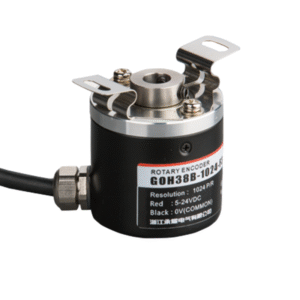
Incremental vs. Absolute Linear Encoders: Key Differences
Incremental linear encoders provide relative position data by generating pulses as the scale and readhead move. Each pulse represents a fixed distance. They rely on counting pulses from a reference point, which means if power is lost, the position info is lost too — requiring a homing routine to reset the system.
On the other hand, absolute linear encoders produce a unique digital code for each position along the scale. This code instantly shows the exact position without needing to count pulses or perform homing after power outages.
| Feature | Incremental Linear Encoder | Absolute Linear Encoder |
|---|---|---|
| Position Type | Relative (pulse counting) | Absolute (unique position code) |
| Power Loss Impact | Position lost, needs homing | Position retained, no homing needed |
| Cost | Lower cost | Higher cost |
| Electronics Complexity | Simpler | More complex |
| Speed Potential | Generally faster pulse outputs | Slightly slower due to data processing |
| Ideal Use Conditions | Applications with known reference or short resets | Critical position tracking with no loss |
When to Choose Incremental or Absolute
- Opt for incremental linear encoders if your system can easily handle homing cycles and you want a cost-effective, high-speed feedback solution.
- Choose absolute encoders when power interruptions are frequent or when immediate, unique position feedback is essential, such as in high-precision automation or safety-critical applications.
Real-world choices often come down to factors like accuracy needs, system complexity, and budget.
For a detailed comparison in the rotary encoder field, see our guide on absolute vs incremental rotary encoders, which shares many principles relevant to linear encoders too.
Also, explore the key advantages of incremental encoders over absolute encoders for more insights that might help in making your selection.
Types of Incremental Linear Encoders
Incremental linear encoders come in several types, each suited to different applications and environments. Here’s a quick rundown:
Optical Incremental Linear Encoders
These use light passing through or reflecting off a finely patterned scale (usually glass or plastic). They offer high resolution and accuracy, ideal for clean environments like CNC machines and precision metrology. The common types include shadow and reflective optical encoders.
Magnetic Incremental Linear Encoders
Using a magnetic strip and sensors like Hall-effect or inductive elements, magnetic encoders are great for harsh environments. They resist dirt, oil, and moisture well, making them perfect for longer measuring lengths and industrial settings where contamination is a concern.
Inductive and Capacitive Incremental Linear Encoders
Less common but useful in tough environments, these rely on changes in inductance or capacitance caused by the scale’s movement. They provide good reliability under dust and vibration but often at a lower resolution compared to optical types.
Exposed vs. Enclosed Incremental Encoders
- Exposed/Kit Encoders: These encoders come as parts—scale and readhead—intended for careful installation in clean settings. They’re easier to customize but need more protection.
- Enclosed/Sealed Encoders: Built into robust housings with seals or covers to protect the internal components. Ideal for dirty or wet environments where protection is critical.
Comparison Table: Incremental Linear Encoder Types
| Encoder Type | Resolution | Speed Capability | Environmental Rating | Typical Cost Range | Key Benefit |
|---|---|---|---|---|---|
| Optical | Sub-micron to nm | Very high | Clean to moderate (IP50-IP65) | $$$ – $$$$ | High accuracy |
| Magnetic | Micron-level | High | Harsh (IP65-IP67) | $$ – $$$ | Dirt/moisture resistant |
| Inductive | Moderate | Moderate | Harsh (IP65+) | $ – $$ | Vibration/dust resistant |
| Capacitive | Moderate to high | Moderate | Moderate (sealed options) | $$ | Stable in dusty environments |
| Exposed/Kit | Variable | Variable | Low (needs protection) | $ – $$ | Customizable, cost-effective |
| Enclosed/Sealed | Variable | Variable | High (IP65+) | $$ – $$$$ | Rugged, ready for harsh use |
Each type has its strengths, so picking the right incremental linear encoder depends on your resolution needs, environment, and budget. For a more detailed look at different incremental encoder technologies and maintenance tips, check out this detailed overview of common incremental encoder types.
Key Specifications and Selection Criteria for Incremental Linear Encoders
Choosing the right incremental linear encoder involves focusing on several important specs to ensure your application runs smoothly.
Resolution and Accuracy
- Measures movement precision, typically from sub-micron to nanometer levels.
- Resolution depends on the scale’s pulses per mm and interpolation of signals.
Measuring Length and Scalability
- Available lengths range from a few millimeters to several meters.
- Modular designs allow easy scaling for longer measurement ranges.
Speed Capability and Output Frequency
- Determines how fast the encoder can track movement without signal loss.
- High-speed applications need encoders supporting output frequencies up to several hundred kHz.
Output Interfaces
- Common output signals include:
- TTL (Transistor-Transistor Logic)
- RS422 differential
- Open collector for flexible integration
- Selecting the right interface ensures compatibility with your control system.
Environmental Protection
| Specification | Details |
|---|---|
| IP Rating | IP40 to IP67, sealed options for harsh environments |
| Temperature Range | Typically -20°C to 85°C, some models to 125°C |
| Contamination | Dust, oil, and coolant resistance vary by model |
Mounting and Installation
- Gap tolerance: Proper distance between readhead and scale (usually 0.1–0.3 mm) is critical.
- Alignment: Accurate parallelism avoids signal loss or errors.
Repeatability, Hysteresis, and Signal Stability
- Repeatability ensures consistent readings under repeated motions.
- Low hysteresis reduces lag or error when changing direction.
- Stable signals minimize noise, essential for precise linear position feedback.
For practical integration tips and output interface details, you might explore the overview on understanding incremental encoder outputs.
A clear grasp of these specifications helps you pick the best high-resolution linear encoder suited for your industrial linear motion sensor needs.
Common Applications and Industries for Incremental Linear Encoders
Incremental linear encoders are widely used across many industries thanks to their precise position feedback and fast response. In CNC machines, milling, and precision machining, they provide reliable linear position sensing, critical for accurate cuts and tool positioning. These industrial linear motion sensors ensure smooth automated operations in industrial automation and robotics, where real-time position data is essential.
In semiconductor manufacturing and electronics assembly, incremental linear encoders deliver the sub-micron resolution necessary for delicate component placement. Similarly, packaging, woodworking, and metalworking industries rely on rugged magnetic incremental linear encoders or optical variants that withstand harsh environments and contaminants.
For metrology and quality control, including coordinate measuring machines (CMM), these encoders offer highly repeatable measurements, vital for precise inspection and calibration. In medical equipment and high-speed printing, the fast output and high accuracy of incremental linear encoders enable smooth, reliable motion control.
Choosing the right linear encoder with index pulse or quadrature output encoder depends on the application’s needs for resolution, speed, and environmental resistance. For example, in industrial setups, encoders from trusted suppliers like sensyor ensure quality and rapid delivery, supporting a wide range of automated systems.
Advantages and Limitations of Incremental Linear Encoders
Incremental linear encoders offer several clear advantages for many industrial and automation tasks. They are cost-efficient, typically cheaper than absolute encoders, making them ideal for projects with budget constraints. These encoders also provide high resolution potential, allowing precise linear position sensing down to sub-micron levels when combined with interpolation. Their fast response time is a big plus in high-speed applications, and their simple electronics design ensures easy integration into existing systems.
However, there are some limitations to consider. Incremental encoders only provide relative position data, so they lose track of their position if power is lost. This means a homing or reference move is necessary after each power cycle for accurate readings. In certain environments, especially those with heavy contamination or vibration, the signal quality can be affected, making them somewhat sensitive to dirt and interference.
To address these challenges, practical mitigation strategies include:
- Using the built-in index pulse for precise referencing and repeatability.
- Adding backup batteries or uninterruptible power supplies to maintain position data during outages.
- Implementing hybrid systems that combine incremental sensing with some absolute feedback to improve reliability.
These approaches help maximize the effectiveness of incremental linear position sensors in demanding conditions, balancing cost with accuracy and operational stability.
For more details on optimizing incremental encoder signals and integration, you might find insights on high-frequency counter technology useful in achieving stable, precise measurements. For example, well-designed products often leverage advanced counter inputs as explained in the CY7 high-frequency counter precision timing and reliability for modern engineers overview.
Installation, Wiring, and Integration Best Practices
Proper installation and wiring can make a big difference in getting the most from your incremental linear encoder. Here are some key tips to ensure optimal performance and reliability:
Mounting Guidelines for Optimal Performance
- Maintain correct gap: Keep the specified distance between the readhead and the scale. Too close or too far affects signal quality.
- Ensure parallel alignment: The readhead should be parallel to the scale to avoid signal loss and maintain accuracy.
- Secure mounting: Use rigid, vibration-resistant mounting to prevent movement that can cause measurement errors.
- Avoid contamination: Install in a protected environment or use sealed models if dust, oil, or moisture are present.
Signal Conditioning and Noise Reduction
- Use shielded cables: Minimizes electromagnetic interference (EMI) that can corrupt signals.
- Proper grounding: Establish a consistent ground reference to prevent ground loops and electrical noise.
- Twisted pair wiring: For differential outputs like RS422, twisted pairs reduce noise pickup over long cable runs.
- Signal filtering: Employ external filters or built-in electronics to clean signals for stable readings.
Interfacing with PLCs, Controllers, and Drives
- Match output type: Confirm the encoder output (TTL, RS422, open collector) suits your controller’s input.
- Check input voltage levels: Ensure voltage compatibility to prevent damage or faulty signals.
- Use appropriate connectors: Secure and durable connectors reduce wiring faults and downtime.
- Implement quadrature decoding: Many controllers can decode incremental signals (A/B channels) to track position and direction accurately.
Calibration and Homing Procedures
- Establish a reference point: Use the encoder’s index pulse to set a zero or home position every startup.
- Run homing routines: Automate homing in controllers to reset position after power loss and ensure correct absolute positioning.
- Verify linear scale alignment: Double-check alignment during setup to avoid cumulative errors.
- Regular maintenance checks: Periodically inspect mounting, wiring, and signal quality for consistent performance.
Applying these practices will help your incremental linear position sensor deliver precise, reliable feedback for your industrial automation or CNC linear encoder systems. For detailed installation tips and technical guidance, check out our comprehensive encoder guide to ensure smooth integration into your setup.
Choosing the Right Supplier and Manufacturer
Selecting the right supplier for your incremental linear encoder is crucial to ensure quality, reliability, and project success. Here are key factors to consider when choosing a manufacturer:
- Customization Options: Look for suppliers who can tailor encoder designs to your specific needs, including scale length, resolution, and output type.
- Quality Certifications: Verify certifications like ISO9001, which guarantee consistent manufacturing standards.
- Technical Support: Choose manufacturers offering strong after-sales support and application guidance to help integrate encoders seamlessly.
- Lead Time & Delivery: Reliable suppliers provide fast shipping and clear timelines to keep your projects on schedule.
- Price Competitiveness: Get quotes that balance cost and quality to maximize your budget without compromising performance.
Global Manufacturing Trends
The demand for high-precision, customizable, and cost-effective incremental linear encoders is rising worldwide. Asian manufacturing hubs like China and Taiwan lead in volume production, while Europe and the U.S. focus on premium quality and innovation. Automation and Industry 4.0 integration are pushing manufacturers toward smart encoder solutions with enhanced diagnostics and connectivity.
Why Partner with Sensyor?
Sensyor stands out as a trusted incremental linear encoder manufacturer and supplier, offering:
| Feature | Sensyor Advantage |
|---|---|
| Custom Solutions | Tailored encoder designs to fit your unique requirements |
| Competitive Pricing | Cost-effective choices without quality compromise |
| Reliable Quality | High-grade components and strict quality controls |
| Fast Delivery | Efficient production and shipping processes |
| Technical Support | Expert assistance from design to integration |
Sensyor’s commitment to quality and innovation makes it an excellent partner for businesses needing industrial linear motion sensors or precision linear displacement measurement tools. Explore how to select encoders for your automation projects with insights from Sensyor’s guide on choosing the right encoders for your B2B project.
Choosing a supplier like Sensyor gives you peace of mind with both cost and performance for your incremental linear position sensor needs.