How to Choose the Right Encoders for Your B2B Project?
In the world of industrial automation and machinery manufacturing, encoders play a crucial role. Think of them as the “eyes” and “ears” of your equipment, helping machines accurately sense position, speed, and direction for precise control. For B2B projects, selecting the right encoder not only affects your equipment’s performance and stability but also directly impacts your project’s cost-effectiveness and delivery schedule.
So, how do you pick the best encoder from a sea of options? This article will guide you through the basics, application needs, and key selection criteria for encoders—helping you make a smart choice.
Encoder Basics and Types Overview
Let’s start with the basics. An encoder is a sensor that converts mechanical motion into electrical signals. Encoders can measure rotational angles, linear positions, or speed, providing feedback for control systems.
Main types of encoders:
Incremental Encoders
Output pulse signals to reflect movement changes, suitable for speed measurement and simple positioning.
Absolute Encoders
Each position has a unique code, maintaining the current position even after power loss—ideal for complex positioning needs.
Linear Encoders
Measure linear displacement and are widely used in CNC machines and precision measurement devices.
Magnetic & Optical Encoders
Optical encoders offer high precision but require clean environments; magnetic encoders are more robust and suitable for harsh conditions.
Common B2B Application Scenarios and Needs Analysis
Every industry and project has unique requirements for encoders. Understanding your application scenario helps you choose the right solution.
- Automated Production Lines: Need high-speed response and durable encoders.
- Robotics: Require high precision and resolution for accurate movement.
- CNC Machines: Demand high accuracy and repeatability.
- Packaging Machinery: Need stable encoders that can handle high-speed operation.
- Medical Devices: Require high reliability and safety.
Key parameters include:
- Resolution: Determines the fineness of measurement.
- Accuracy: Affects the final product’s quality.
- Response Speed: Adapts to high-speed movement.
- Lifespan and Maintenance: Reduces downtime and maintenance costs.
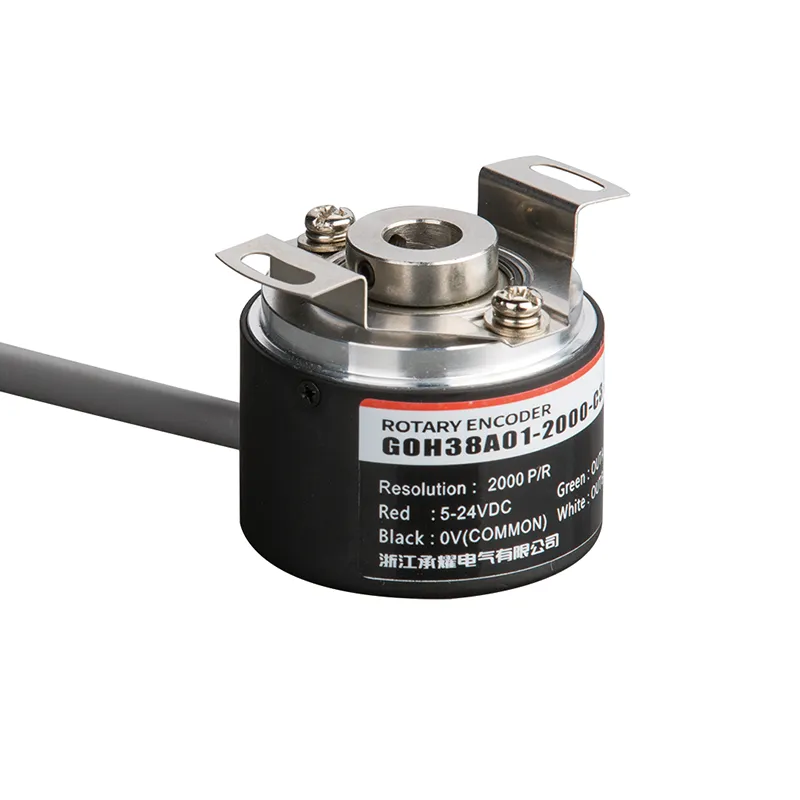
Key Factors to Consider When Choosing an Encoder
Selecting an encoder isn’t about picking the most expensive one—it’s about finding the best fit. Here are some essential factors:
- Application Environment
- Temperature range, dust and water protection (IP rating), vibration resistance.
- For example, magnetic encoders are ideal for outdoor or dusty environments.
- Installation Space and Method
- The encoder’s size and installation method must match your equipment.
- Output Signal Type
- Analog or digital signals, and whether the interface matches your control system.
- System Compatibility
- Can the encoder integrate seamlessly with PLCs, servo drives, or other devices?
- Cost and Maintenance
- Balancing initial investment with long-term maintenance costs.
Incremental Encoders vs. Absolute Encoders
| Feature | Incremental Encoder | Absolute Encoder |
|---|---|---|
| Position Memory | No | Yes |
| Power Loss | Needs re-zeroing | Retains position |
| Cost | Lower | Higher |
| Typical Uses | Speed measurement, simple positioning | Precise positioning, complex control |
In short, incremental encoders are suitable for applications where position memory isn’t critical and are more cost-effective. Absolute encoders are ideal for critical applications that require position retention after power loss, offering more features at a higher price.
Industry Case Studies and Selection Process
For example, an automated assembly line project needed real-time monitoring of robotic arm position and speed. After analyzing the requirements, a high-resolution absolute encoder was chosen to ensure the robotic arm could quickly resume the correct position after a power outage, avoiding production interruptions.
Encoder selection process:
- Clarify project requirements: Understand the application environment, accuracy, and response speed needs.
- Evaluate environmental factors: Consider temperature, protection rating, and vibration.
- Compare parameters and models: Look at resolution, interface type, and lifespan.
- Contact suppliers: Request samples for testing and confirm compatibility.
- Finalize selection: Decide based on cost and after-sales service.
Choosing the right encoder is a critical step for any successful B2B project. It affects equipment performance, production efficiency, and cost control. We hope this article has given you a clear understanding of encoder types, applications, and selection essentials.
If you’re looking for a reliable encoder solution for your project, feel free to contact our professional team. We offer a wide range of high-quality encoders and can customize solutions based on your specific needs. Don’t hesitate—send us your inquiry now and let’s make your project a success together!
FAQ
How do you estimate the lifespan of an encoder?
Encoder lifespan depends on mechanical structure and usage environment. Manufacturers usually provide a rated lifespan, but proper maintenance and environmental protection can extend it.
How do you ensure encoder compatibility?
Check if the encoder’s output signal matches your control system interface. It’s best to test samples for verification.
What are common mistakes in the selection process?
1. Focusing only on price and ignoring performance.
2. Overlooking environmental factors, leading to early failure.
3. Ordering in bulk without sample testing.