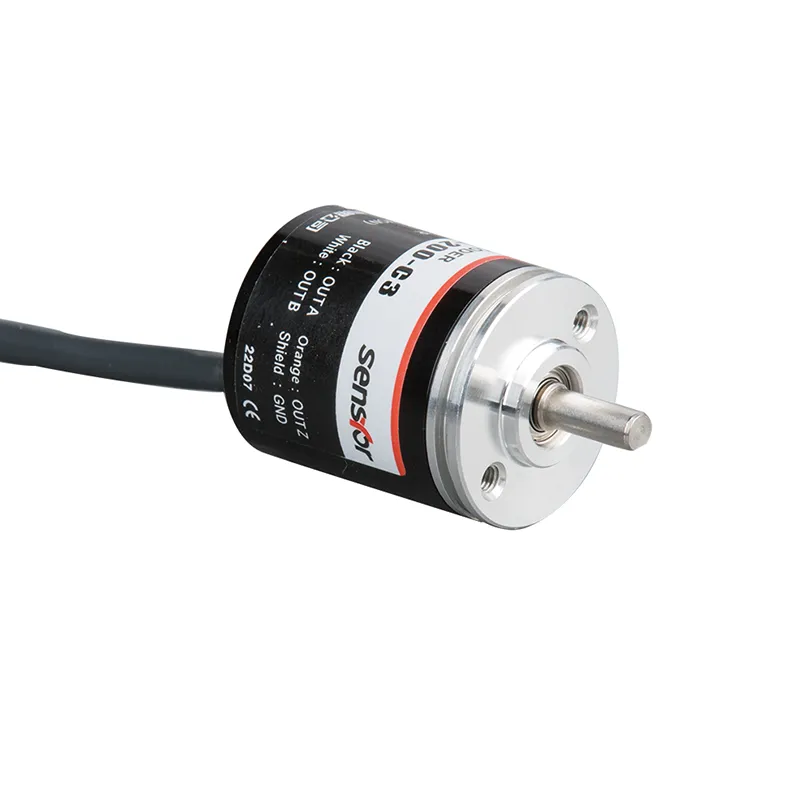
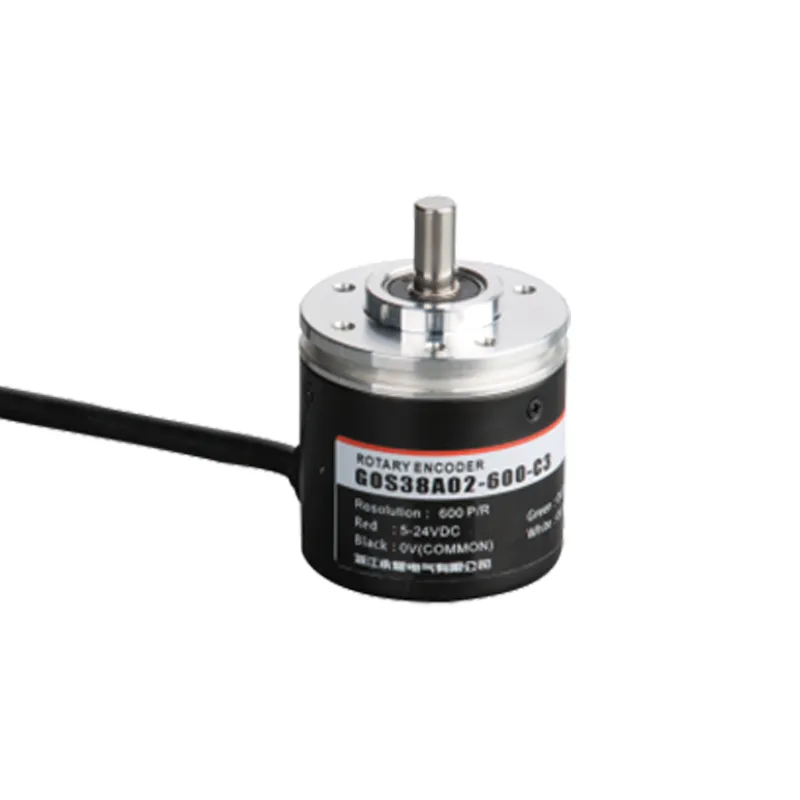
Incremental rotary encoders convert mechanical rotation into electrical signals that machines use to track position and speed. The core mechanism involves a rotating disk paired with a stationary sensor setup.
The Mechanism: Rotating Disk and Stationary Mask
Rotating Disk: This disk can be optical or magnetic. For optical encoders, the disk has transparent and opaque segments arranged around its circumference. For magnetic encoders, magnetic poles are arranged instead.
Stationary Mask or Sensor: Fixed opposite the disk, it detects changes as the disk spins. In optical encoders, a light source shines through the rotating disk and hits a photodetector. In magnetic types, the sensor detects shifts in the magnetic field.
As the disk rotates, the alternating opaque and transparent (or magnetic) sections modulate the sensor input.
Pulse Generation: Translating Movement into Signals
Each time the sensor detects a change—whether a light beam blocked or a magnetic field shift—it generates a square wave pulse. These pulses represent increments of movement.
Understanding Channels A, B, and Z
Channel A & B – Quadrature Encoding
These two channels produce pulses offset by 90 degrees.
By comparing the phase difference, the encoder determines both speed and direction of rotation.
This method is known as quadrature encoding, essential for precise motion control feedback.
Channel Z – The Index Pulse
This single pulse occurs once per full revolution.
It acts as a reference or “home” position, allowing systems to reset and calibrate angular position sensors.
Essential for applications requiring absolute alignment within relative positioning systems.
In , incremental rotary encoders use a rotating disk and stationary sensor mask to generate pulses that machines interpret via channels A, B, and Z, enabling accurate speed, direction, and position tracking.
Incremental vs. Absolute Encoders: Making the Right Choice
When deciding between incremental rotary encoders and absolute encoders, understanding their core differences is key. Incremental encoders generate pulses as the shaft rotates, but they lose position data when power is cut. That means after a power loss or system reset, the controller cannot know the exact position until the encoder re-calibrates — unlike absolute encoders, which keep track of the exact angular position at all times thanks to unique coding on their disks.
Cost and complexity also play a big role in choosing incremental encoders. They tend to be more affordable and have simpler wiring setups compared to absolute encoders. This makes incremental encoders the industry standard for speed measurement and relative positioning, especially when precise position hold-through power cycles isn’t critical.
Common best use cases for incremental encoders include conveyor belts where speed feedback is enough, motor speed control in industrial automation, and cut-to-length applications where relative movement tracking is required. For these tasks, incremental encoders provide reliable rotary pulse generation without unnecessary complexity or cost.
If you’re interested, Sensyor offers a range of incremental encoders, such as the GOS5008B Rotary Encoder designed for industrial feedback loop control with options that fit a variety of shaft encoder specifications.
Critical Technical Specifications for Selection
When choosing an incremental rotary encoder, key specs affect both performance and compatibility. Here’s what to focus on:
Resolution (PPR)
Pulses Per Revolution (PPR) defines how many pulses the encoder outputs per full shaft turn.
High PPR means better position and speed precision.
Too high a PPR can overwhelm your controller due to frequency limits.
Balance precision with your controller’s max input frequency for smooth control.
Output Circuits
Type
Description
Best Use Case
Open Collector (NPN/PNP)
Simple output for PLCs, needs pull-up resistors
Standard industrial automation sensors, easy PLC hookup
Line Driver (RS422)
Differential signals for noise immunity and long distance
Harsh environments, long cable runs
Push-Pull (HTL)
Supports wide voltage range, robust and versatile
Versatile installations, moderate distances
Mechanical Sizing
Shaft diameter and housing size are crucial for compatibility.
Compact designs like the φ25mm standard fit tightly in robots and miniature motors without sacrificing durability.
Correct mechanical sizing avoids misalignment and bearing stress, extending encoder life.
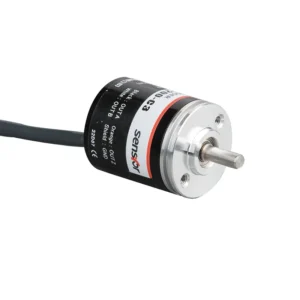
For more details on compact rotary encoders and robust options, check out the GOS25C Rotary Encoder series from Sensyor. This line offers ideal balance in size, resolution, and output types for precise motion control feedback.
Spotlight on Sensyor Solutions: The GOS25C Series
Compact Design: The GOS25C Rotary Encoder (φ25mm)
The GOS25C Series from Sensyor perfectly shows why compact incremental rotary encoders are crucial for tight spaces like robotics and miniature motor applications. Its small φ25mm housing lets you fit a high-quality shaft encoder specification right where bulky sensors just won’t do. This compact size ensures seamless integration without sacrificing performance, making it a go-to for precision motion control feedback in space-constrained environments. For a closer look, check out the detailed specs on the GOS25C Rotary Encoder.
Durability: Built to Last in Harsh Conditions
Durability is critical for industrial automation sensors, and Sensyor designs the GOS25C with robust IP ratings that protect against dust and moisture, extending service life even in tough factory settings. Its rugged build includes shock resistance to withstand sudden impacts, plus bearing load capabilities that ensure reliable angular position sensing during continuous operation. These features reduce downtime and maintenance, vital for demanding conveyor belt or motor speed feedback systems.
Performance: Fast Response and Stable Signals
When it comes to performance, the GOS25C incremental encoder shines with high-frequency response and stable output signals, critical for precise feedback loop control. Its push-pull output circuit supports clean A/B/Z phase output pulses, helping minimize noise and jitter for accurate pulses per revolution (PPR) detection. Whether you need high-resolution rotary pulse generation or reliable speed and direction measurement, the GOS25C delivers consistent results under heavy industrial use.
The Importance of Supplier Customization
Beyond Off-the-Shelf: Why Standard Encoders Don’t Fit Every Machine
In industrial automation, no two machines are exactly the same. While standard incremental rotary encoders are reliable, they often fall short when precise shaft sizes, cable lengths, or pulse requirements are needed for unique control systems. This is where customization becomes critical—off-the-shelf products can’t always meet specific application challenges, especially in tight spaces or specialized feedback loops.
Sensyor’s Customization Capabilities
Sensyor understands these nuances and offers tailored solutions to fit diverse industrial needs. Their incremental shaft encoder customization includes:
Modifying Shaft Dimensions (Solid vs. Hollow): Adjusting shaft type and size to match your motor or machine interface, ensuring seamless integration and reducing installation hassles.
Custom Cable Lengths and Connector Types: Catering to different layouts by providing cables and connectors that match your exact factory floor requirements, avoiding excess clutter or signal loss.
Specific PPR Configurations Tailored to Unique Control Loops: Offering flexible pulses per revolution (PPR) settings to match your controller’s frequency limits and desired resolution for precise speed and position feedback.
By choosing customizable incremental encoders from Sensyor, you get a perfect fit that enhances your system’s reliability and performance without the typical compromises of standard encoder specs. For detailed options on precision incremental shaft encoders, explore Sensyor’s incremental encoders customization services.
Installation and Noise Mitigation
Proper installation is key to getting the best performance from your incremental rotary encoder. When mounting, it’s crucial to use flexible couplings to connect the encoder shaft to the motor or machine shaft. This helps prevent bearing damage caused by shaft misalignment or vibrations, ensuring a longer lifespan for your encoder.
For wiring, good shielding practices are a must to avoid electrical noise interference, especially the EMI generated by variable frequency drives (VFDs) and motors. Using shielded cables and grounding them properly reduces signal distortion and keeps your quadrature encoding signals clean. This means more accurate speed and position feedback for your motion control system.
If you need reliable mounting accessories, consider exploring flexible coupling solutions available at trusted providers like Sensyor for hassle-free installation that protects your rotary pulse generator from mechanical stress. Their coupling series offers versatile options tailored for industrial automation sensors.
Maintaining these installation and wiring hygiene standards will significantly improve the stability and lifetime of your incremental encoder’s output signals, crucial for any feedback loop control in industrial applications.
Choosing the right encoder for an industrial automation system can feel like navigating a maze — so many options, each promising precision and efficiency. Among these, incremental encoders often stand out thanks to their reliability and cost-effectiveness. Yet, when maintenance and long-term upkeep enter the picture, the question becomes: which encoder is actually easier to maintain — incremental […]
We use cookies to enhance your browsing experience, serve personalised ads or content, and analyse our traffic. By clicking "Accept All", you consent to our use of cookies.