Absolute vs Incremental Rotary Encoder Key Differences and Industry Applications
When you’re sourcing precision feedback devices for motion control systems or automation projects, one of the first questions that comes up is simple but crucial: Should I choose an absolute or incremental rotary encoder?
If you’re an engineer, a purchasing manager, or anyone involved in industrial automation, understanding this difference isn’t just a matter of preference — it directly impacts your system’s accuracy, cost-efficiency, and reliability.
Let’s explore what sets these two encoder types apart, when to choose one over the other, and how they perform across various use cases.
What Is a Rotary Encoder?
Before diving into “absolute vs incremental rotary encoders,” let’s clarify what a rotary encoder actually does.
A rotary encoder is a position sensor that converts the rotation of a shaft into an electrical signal. This signal then provides data about position, speed, and direction to a control system. In automation, robotics, CNC machines, and servo drives, encoders act as the system’s “eyes,” helping it track movement precisely.
There are two main types of rotary encoders:
- Absolute Rotary Encoders
- Incremental Rotary Encoders
Both perform similar functions — yet the way they deliver data makes a big difference.
How Absolute and Incremental Rotary Encoders Work
Here’s a quick technical comparison of how each type operates.
| Feature | Absolute Encoder | Incremental Encoder |
|---|---|---|
| Output signal | Unique code for each shaft position | Series of pulses per revolution |
| Position reference | Retains position even after power loss | Loses position when power is off |
| Initialization | No homing needed | Requires homing at startup |
| Accuracy | High — absolute positioning | Moderate — depends on resolution and counting electronics |
| Price level | Generally higher | More economical |
| Typical applications | Robotics, elevators, medical devices, servo motors | Conveyor systems, motor speed feedback, packaging machines |
In short:
- Absolute encoders provide specific position values right away.
- Incremental encoders provide relative motion data that must be counted from a reference point.
Absolute Rotary Encoders Explained
Absolute rotary encoders assign a unique digital value to every shaft position. Think of it like a GPS system: no matter when you turn it on, it instantly knows where you are.
They use optical, magnetic, or capacitive sensing methods and are available in single-turn or multi-turn configurations.
- Single-turn absolute encoders measure one rotation (360°).
- Multi-turn encoders count multiple revolutions, often up to thousands, keeping track even if the power is lost.
Key Advantages of Absolute Encoders
- No need for recalibration or homing after power loss.
- Offer true position tracking — reliable in systems that require precision and safety.
- With digital communication protocols like SSI, BiSS, CANopen, or EtherCAT, they integrate easily with PLCs and industrial controllers.
Common Industrial Applications
Absolute encoders are commonly used in:
- Robotics for joint position feedback.
- Medical imaging systems for precise table or scanner movement.
- CNC machinery for multi-axis control.
- Elevators and cranes, where safety and continuity are critical.
If your system must always know the exact shaft position — even after a power cut — an absolute rotary encoder is your best ally.
Incremental Rotary Encoders Explained
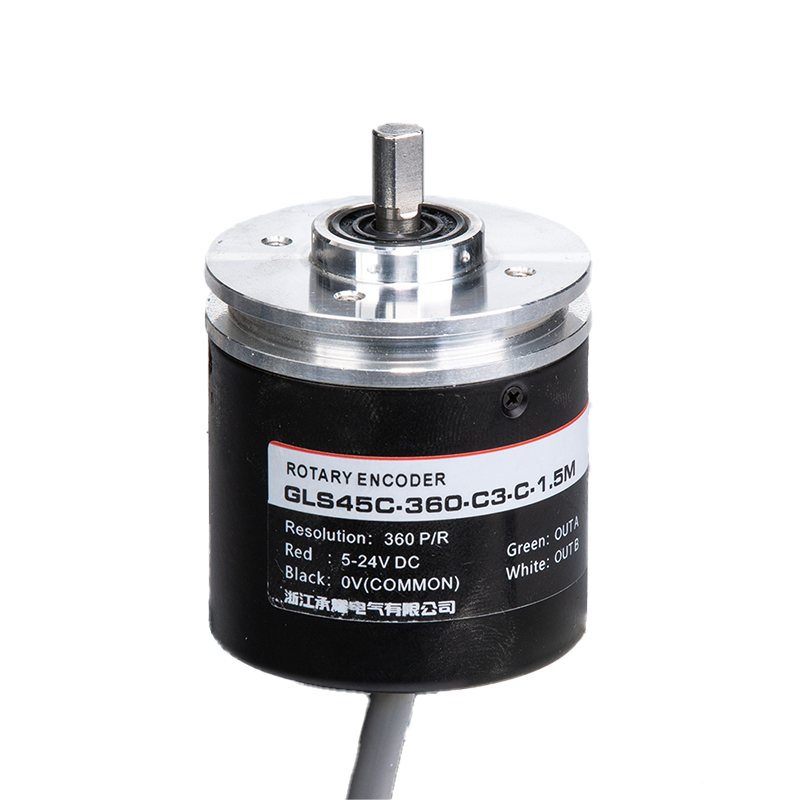
Incremental encoders, on the other hand, are like a stopwatch. They measure movement relative to a starting point but lose track when power is off.
Their output consists of pulses — counts that represent increments of rotation. The system must reference itself (home position) each time it boots up.
Key Advantages of Incremental Encoders
- Simpler and more affordable.
- Excellent for applications focused on speed and direction monitoring.
- Easy to install and maintain — a favorite for engineers handling multiple machines.
- Compatible with TTL or HTL signal interfaces, making integration straightforward.
Common Industrial Applications
Incremental encoders fit well in:
- Conveyor belts and drive shafts to measure speed or distance.
- Printing and packaging machines where repeated motions dominate.
- Servo systems requiring speed feedback rather than position memory.
- Factory automation lines where cost-efficiency and volume manufacturing matter most.
Key Technical Comparison at a Glance
| Parameter | Absolute Encoder | Incremental Encoder |
|---|---|---|
| Signal Type | Parallel or serial digital output | A/B/Z pulses |
| Data Retention | Yes, retains position | No, resets when off |
| Resolution | Up to 22-bit per revolution | Depends on pulses per revolution (PPR) |
| Startup Time | Instant readiness | Requires referencing |
| Interface Protocols | SSI, Profibus, CANopen, EtherCAT | Line driver, push-pull |
| Maintenance | Low | Moderate |
| Cost | Higher | Lower |
| Suitable Environments | Dynamic, safety-critical systems | Repetitive motion control |
Choosing Between Absolute vs Incremental Rotary Encoder
So, when should you select absolute over incremental, or vice versa?
Here’s a practical breakdown:
- If your system needs to resume instantly after a shutdown — go with absolute encoders. They save time and prevent accidents.
- If cost-efficiency is your top concern — incremental encoders do the job well, especially for simpler automation tasks.
- If high resolution and fail-safe operation are critical — absolute types offer superior performance.
- If you prioritize rapid movement or velocity feedback — incremental encoders handle speed sensing beautifully.
A good purchasing rule of thumb:
- Motion control = Absolute
- Speed control = Incremental
Still unsure which encoder suits your machine setup? Our technical sales engineers can help you pick the ideal model — contact us for a quick consultation or quotation.
Why the Choice Matters More Than Ever
In the era of Industry 4.0, machine intelligence depends on reliable data feedback. Choosing the right rotary encoder influences not only precision but also data connectivity, safety compliance, and predictive maintenance.
Trends shaping the market include:
- EtherCAT and IO-Link encoders for smart factories.
- Miniaturized encoder solutions for collaborative robots (cobots).
- Magnetic encoders gaining popularity due to dust and vibration resistance.
- Hybrid encoders combining absolute and incremental signals for redundant feedback.
Modern engineers seek encoders that aren’t just accurate, but also network-ready and cyber-secure, especially for applications tied to industrial IoT (IIoT) or automation analytics.
Common Misconceptions About Absolute vs Incremental Rotary Encoder
Even experienced professionals mix up a few things. Let’s clear them up.
- Myth 1: Incremental encoders can’t measure absolute position.
Reality: They can, but only once the reference point is set — losing data after power interruption. - Myth 2: Absolute encoders are only for high-end robotics.
Reality: Prices have decreased significantly. Many mid-tier machines now use compact absolute models. - Myth 3: Magnetic encoders are less accurate.
Reality: Modern magnetic encoders achieve exceptional accuracy and outperform optical encoders in harsh environments.
Absolute vs Incremental Rotary Encoder Maintenance and Installation Tips
To maximize Absolute vs Incremental Rotary Encoder life and accuracy:
- Avoid cable strain and ensure proper shielding for signal integrity.
- Keep encoders away from high electromagnetic interference.
- Regularly check for bearing wear or dust accumulation.
- For incremental models, apply a consistent homing cycle after maintenance.
- Consider sealed or IP-rated housings for outdoor or high-vibration applications.
You can learn more or request a tailored encoder specification sheet — simply send us your machine details, and our experts will recommend suitable models.
Deciding between Absolute vs Incremental Rotary Encoder isn’t just a technical choice — it’s a strategic one. The right encoder enhances motion accuracy, minimizes downtime, and improves your system’s ROI.
Absolute encoders shine in applications demanding precision and safety, while incremental types are excellent for scalable, cost-sensitive systems.
If your project involves machine automation, motor feedback, or robotics integration, our engineers can help you select the most durable and compatible encoder solution for your needs.
FAQ
u003cstrongu003eCan absolute and incremental encoders be used together?u003c/strongu003e
Yes. Many modern motion control systems combine both. Absolute encoders provide initial position data, while incremental channels monitor speed.
u003cstrongu003eAre absolute encoders harder to integrate?u003c/strongu003e
Not really. Communication protocols like u003cemu003eCANopenu003c/emu003e and u003cemu003eEtherCATu003c/emu003e simplify installation even in complex automation systems.
u003cstrongu003eDo incremental encoders offer enough precision for servo motors?u003c/strongu003e
Yes — as long as the encoder’s resolution (PPR) matches your control system’s requirements.
u003cstrongu003eHow do I choose between optical and magnetic encoders?u003c/strongu003e
Choose u003cstrongu003eopticalu003c/strongu003e for ultra-high resolution in clean environments, and u003cstrongu003emagneticu003c/strongu003e for robust performance in dusty or vibration-heavy areas.
u003cstrongu003eWhat about encoder power supply?u003c/strongu003e
Most encoders operate within u003cstrongu003e5 VDC or 10–30 VDCu003c/strongu003e, depending on output type. Always verify compatibility with your controller.