Incremental Rotary Encoder Selection Guide for Buyers
When you’re on the factory floor, there’s not a lot of time for “I wonder what this encoder does.” An incremental rotary encoder is usually the quiet superstar of your motion‑control system, quietly telling your controller how fast, how far, and in which direction the motor or shaft is moving.
In this guide, I’m going to talk as a B2B‑focused product expert, not as a textbook. You’ll learn how to choose the right incremental rotary encoder, how to hook it up correctly, and what to watch out for when you place your order.

What an incremental rotary encoder really does
At a basic level, an GOS38AO3 incremental rotary encoder counts little steps as the shaft turns. Instead of giving you “I’m at 127.3°,” it sends a stream of pulses—often called pulses per revolution (PPR)—and your controller does the math to track position and speed.
Because of that behavior, many industrial buyers like incremental encoders for motion feedback in CNC machines, conveyor drives, servo systems, and robotic joints. They’re usually cheaper and simpler than absolute encoders, and they integrate cleanly with common PLCs and motion controllers.
Let’s make this concrete:
- A 1,000 PPR incremental rotary encoder gives you 1,000 pulses every full turn of the shaft.
- If you read the rising edges of Channel A, you get 1,000 counts per revolution.
- If you track both A and B using quadrature, you can effectively get 4× the counts, which is common in high‑precision motion control.
That’s why you’ll often see B2B catalogs mention “quadrature output” or “2‑channel A/B with Z‑index”—these are exactly the specs engineers care about when designing a reliable motion‑feedback loop.
How to connect an incremental rotary encoder
Now let’s get hands‑on: how do you actually wire this thing? Knowing the wiring won’t just help you debug faster; it also gives you more confidence when you’re talking to a supplier or reviewing your machine’s datasheet.
A typical incremental rotary encoder has three main channels:
- Channel A – main pulse output.
- Channel B – same pulse rate, but shifted in phase so you can tell the direction.
- Index (Z) – one pulse per revolution, often used as a homing or reference mark.
On top of that, you’ll usually find:
- Positive supply (Vcc) – often 5 VDC or 24 VDC, depending on the model.
- Ground (GND) – common reference.
- Optional status/alarm – some encoders provide a fault signal when something goes wrong internally.
Basic incremental encoder wiring example
Imagine you’re hooking up an industrial incremental rotary encoder with 5‑V push‑pull output to a PLC:
- Supply the encoder with 5 VDC on the Vcc terminal and connect GND to the controller’s ground.
- Connect Channel A and Channel B to two digital input channels on your PLC card.
- Connect the Z‑index to a third input if you need homing or calibration.
If your encoder is listed as differential output (A+, A−, B+, B−, Z+, Z−), you’ll connect it to a controller that supports differential signals. That setup is great for long cable runs, noisy environments, or high‑speed applications, because it cancels out common‑mode noise.
Here’s a quick overview of common electrical interfaces you might see in B2B catalogs:
| Output type | Typical use case | Notes for B2B buyers |
|---|---|---|
| Open‑collector | Low‑cost, simple integration | Needs pull‑up resistors; good for short runs. |
| Push‑pull (5 V / 24 V) | General‑purpose industrial machines | Works with most PLCs and motion controllers. |
| Differential (RS‑422) | High‑noise areas, long cables | Better noise immunity; common in factory automation. |
If you’re the buyer or engineer specifying the encoder, you should always ask your controls team: “Does the controller support differential or single‑ended inputs?” Getting that detail right at the design stage can save hours of troubleshooting later.
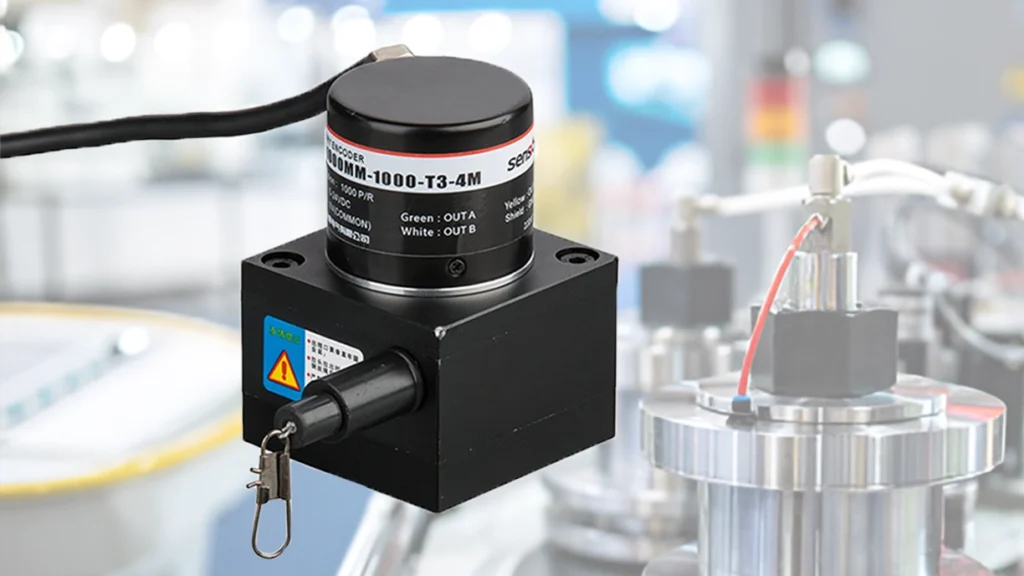
If you’re sourcing incremental rotary encoder solutions for CNC machines,Feel free to contact us at any time.
How to choose the right incremental rotary encoder
Let’s move from “how it works” to “which one should I buy.” As a B2B buyer, you’re not just shopping for a part number; you’re matching an incremental rotary encoder to a real‑world application.
Here are the main decision points we’ll unpack:
- Mechanical form factor (shafted vs. hollow‑bore vs. kit encoder)
- Resolution (PPR) and index marking
- IP rating and environmental robustness
- Output type (single‑ended vs. differential)
- Technical support and lead time
Mechanical fit: shafted, hollow bore, or kit
Many industrial buyers get stuck on this first: does the encoder clamp onto the existing shaft, or do we need to redesign the motor coupling?
- A shafted incremental rotary encoder has its own shaft that you mechanically couple to the motor. Great when you can add a flexible coupling.
- A hollow‑bore (through‑shaft) encoder slides directly over the motor shaft, saving space and reducing offset. Common in compact servo systems and CNC spindles.
- A kit encoder is the bare‑bones option: magnetic‑ring or scale plus sensor, designed to mount directly inside the motor frame. Lower profile, but installation needs more planning.
If you’re sourcing for a medium‑ or high‑volume CNC machine line, you’ll often see hollow‑bore incremental rotary encoders or kit‑style encoders, because they reduce mechanical complexity and alignment work.
Resolution and PPR: how fine is “fine enough”?
B2B product pages often list resolution as pulses per revolution (PPR), and sometimes as counts per revolution (CPR) if they’re using quadrature.
For example:
- A 1,000 PPR encoder gives you 1,000 pulses per turn.
- In quadrature, your controller can count 4,000 edges per turn, which is effectively 4,000 CPR.
In practice, higher resolution is useful when you need:
- Smoother motion in servo drives.
- Better speed control in winding machines.
- Finer position tracking in precision robotics.
But remember: higher resolution demands better signal quality and faster counting electronics. That’s why industrial buyers often pair high‑resolution incremental encoders with differential outputs and shorter cable runs or shielded cables.
Environmental protection and IP ratings
If your machine goes into a factory floor environment, cleanliness and protection matter a lot. That’s where terms like IP65 incremental encoder or IP67 incremental encoder start showing up in B2B catalogs.
- IP65 – dust‑tight, protected against water jets. Suitable for many indoor industrial machines.
- IP67 – dust‑tight, protected against temporary immersion. Good for outdoor equipment, washdown areas, or mobile machinery.
If you’re negotiating with a supplier, you might ask:
- “Is this incremental rotary encoder rated for harsh environments with vibration and dust?”
- “Do you offer both optical and magnetic versions for our application?”
In high‑vibration environments such as heavy machinery or construction equipment, magnetic incremental rotary encoders are often preferred over optical ones, because they’re less sensitive to dust and misalignment.
Here’s a quick comparison table for B2B decision‑making:
What to watch for when sourcing B2B incremental rotary encoders
Buying an incremental rotary encoder for a production line is different from ordering a one‑off part for a lab prototype. You have to think about supply chain stability, lead time, and technical support, not just specs.
Here are some practical questions B2B buyers often consider:
- Lead time and MOQ (minimum order quantity): Do you need a stable supply for a series‑production machine, or are you placing a small engineering‑sample order? Larger volumes usually come with better pricing and more flexible lead‑time options.
- Customization options: Some suppliers offer custom shaft diameters, custom PPR, or special mounting flanges. If you’re building a proprietary machine, those options can save you from redesigning the whole drive train.
- Certifications and documentation: For industrial equipment, buyers often need CE‑marked, RoHS‑compliant, or IEC‑qualified encoders, along with full datasheets and wiring diagrams.
If you’re sourcing incremental rotary encoder solutions for CNC machines, you might also want to ask about compatibility with leading servo drivers (e.g., certain brands of drives or PLCs) and whether the supplier provides application notes or wiring examples.
At the end of the day, you’re not just reading a catalog; you’re deciding which incremental rotary encoder will keep your machine running for years. Those small choices—shafted vs. hollow‑bore, optical vs. magnetic, single‑ended vs. differential—add up to uptime, maintenance cost, and even warranty claims.
If you tell the supplier your exact use case—for example, “incremental rotary encoder for CNC machine feedback” or “IP65 incremental encoder for high‑vibration conveyor”—you’ll get a much sharper recommendation and avoid the risk of over‑ or under‑specifying.
FAQ
What’s the difference between incremental and absolute rotary encoders?
An u003cstrongu003eincremental rotary encoderu003c/strongu003e gives you pulses that track u003cemu003echange in positionu003c/emu003e. It does not “remember” the absolute shaft position after power‑off.u003cbru003eAn u003cstrongu003eabsolute rotary encoderu003c/strongu003e reports a unique code for each position, so the controller knows the angle immediately on startup.
Single‑ended vs. differential output: which one should I choose?
Single‑ended outputs are simpler and work well for u003cstrongu003eshort cable runsu003c/strongu003e and u003cstrongu003elow‑noise environmentsu003c/strongu003e.u003cbru003eDifferential outputs (A+/A−, B+/B−, Z+/Z−) are better for u003cstrongu003enoisy environmentsu003c/strongu003e, u003cstrongu003elonger cablesu003c/strongu003e, or u003cstrongu003ehigh‑speed countingu003c/strongu003e, because they reject common‑mode interference.u003cbru003eIf your machine is going into a u003cstrongu003efactory floor with lots of VFDs and switching loadsu003c/strongu003e, you’ll usually want u003cstrongu003edifferential‑output incremental rotary encodersu003c/strongu003e.
How do I know if the encoder is suitable for harsh environments?
Look for two things: u003cstrongu003eIP ratingu003c/strongu003e and u003cstrongu003etechnology choiceu003c/strongu003e.u003cbru003eFor u003cstrongu003eIP65 / IP67u003c/strongu003e‑rated encoders, you get protection against dust and water jets or temporary immersion.u003cbru003eFor u003cstrongu003evibration and dustu003c/strongu003e, magnetic incremental rotary encoders are often more robust than optical ones.u003cbru003eIf you’re specifying encoders for a u003cstrongu003eharsh‑environment industrial machineu003c/strongu003e, you can ask your supplier for u003cstrongu003etest datau003c/strongu003e, u003cstrongu003etemperature range specificationsu003c/strongu003e, and u003cstrongu003evibration/shock ratingsu003c/strongu003e.
Can I use an incremental rotary encoder for speed control only?
Yes. Many u003cstrongu003econveyor drivesu003c/strongu003e, u003cstrongu003epumpsu003c/strongu003e, and u003cstrongu003efansu003c/strongu003e use incremental encoders purely for u003cstrongu003espeed feedbacku003c/strongu003e, not for precise position control.u003cbru003eIn those cases, you might choose a u003cstrongu003emedium‑resolution PPRu003c/strongu003e and rely on quadrature counting in your PLC to calculate RPM. This is a common way to keep costs down while still getting reliable speed‑loop control.