Incremental Shaft Encoder Choices for OEM Buyers
When I talk with purchasing teams about an incremental shaft encoder, I usually hear the same opening line: “We just need a shaft encoder.” I smile, because that little sentence hides a big engineering story. An incremental encoder does not simply sit on a motor and look important; it generates motion feedback so the control system can count movement, determine direction, and calculate speed from pulse signals.
Most incremental encoders create two pulse trains, usually called A and B, and many also provide a once-per-revolution index pulse, often called Z, for zero reference. That is why incremental rotary encoders remain so common in conveyors, packaging lines, textile machines, small servos, and PLC-based motion systems: they are compact, cost-effective, and fast enough for a lot of real industrial work. If you are evaluating a φ38 mm model such as the GOS38AO4 Rotary Encoder 10000P/R, this is exactly the level where a smart choice saves you from painful rework later.
I also want to be honest from the start: buyers do not win by choosing the cheapest part number on page one. They win by choosing the encoder that the PLC can read cleanly, the shaft can mount correctly, and the maintenance team can replace without inventing new swear words. So let’s talk about the real stuff: what the encoder is telling your machine, how incremental encoders compare with absolute types, what matters in wiring and selection, and how to judge an incremental encoder manufacturer, supplier, factory, exporter, or wholesaler without turning the RFQ into a guessing game.

What the encoder is really telling your machine
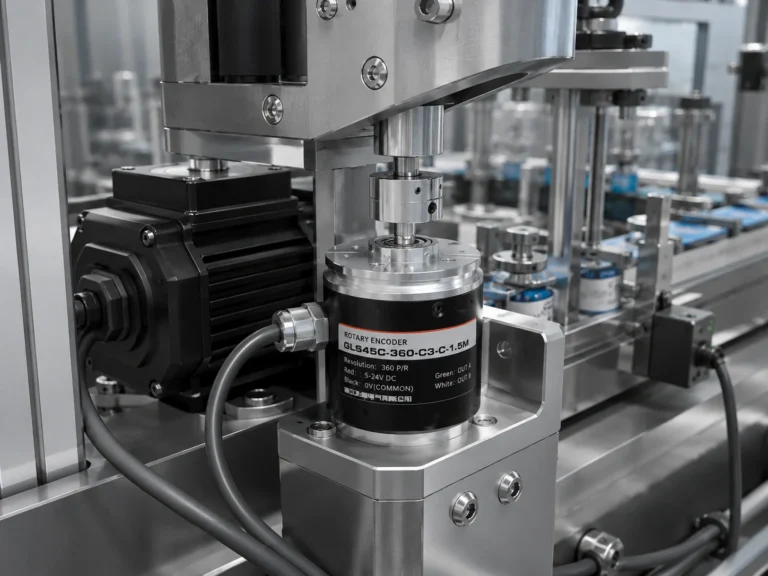
At the signal level, a shaft encoder is simply translating motion into electrical language. In a typical incremental optical encoder, a code disk, light source, and sensor work together so rotation becomes pulses that a controller can count. The two main channels are offset from each other, which lets the control system determine not only that the shaft moved, but also which direction it moved.
This matters more than many buyers expect. If a machine only needs relative movement, speed feedback, or repeatable cycle counting, incremental rotary encoders are often the practical choice because they are usually smaller and more affordable than absolute designs while still offering accurate real-time feedback. In plain English, they do a lot of work without demanding a luxury budget. I love luxury budgets, by the way. I just do not see them often.
For an OEM or plant buyer, the signal structure also shapes the conversation with the controls team. If the encoder provides A, B, and Z outputs, your PLC, counter card, or drive must be ready to receive them properly. If that sounds obvious, good—that means you have already suffered at least one commissioning project.
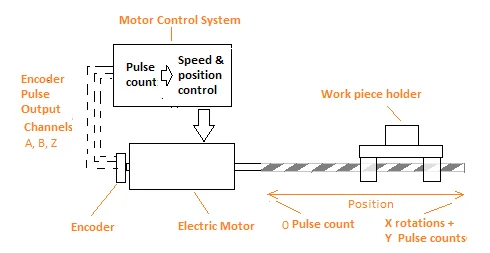
Here is where the phrase incremental shaft encoder becomes important instead of decorative. Because the device tracks change rather than storing an always-known position, it shines in systems where the machine can home quickly, run continuously, and value speed, simplicity, and cost control. That is why I often see incremental optical encoder products chosen in packaging, labeling, indexing tables, and conveyor synchronization tasks.
Another detail buyers should not overlook is scale and resolution behavior. Incremental devices generate pulses based on the encoder scale, and in optical designs the scale pitch can be extremely fine; one source notes interferential optical encoder pitch can be as small as 20 microns. That is one reason an incremental optical encoder can deliver excellent precision in motion systems that need tight repeatability. Of course, precision on paper is only useful if your mechanics, cabling, shielding, and controller input all cooperate—machines, like people, perform best when everyone communicates clearly.
If you are unsure which type of incremental encoder your project requires, please feel free to contact us.
Incremental vs absolute encoder in the real factory
The phrase incremental encoder vs absolute encoder comes up in nearly every serious project review, and it should. Incremental devices provide position change information only, so after a power cycle the actual position is unknown until the machine references or homes to a known point. Absolute encoders, by contrast, provide the actual physical position and retain position data through power loss, which is why they can eliminate homing in many applications.
That sounds like an easy win for absolute, but factory life is rarely that simple. Absolute encoders are typically larger and more expensive, and their multi-track processing or serial communication can add latency compared with the more immediate response of incremental devices. So when I compare incremental vs absolute encoder choices with a customer, I never ask, “Which is better?” I ask, “Which problem are you paying to solve?”
There is also a performance trade-off that buyers should treat seriously: in digital Incremental Shaft Encoder, maximum usable speed is tied to input signal frequency, and higher resolution pushes that frequency upward, which means speed capability may need to be derated as resolution increases. Put bluntly, more PPR is not a free lunch. If someone asks for extremely high resolution on a fast shaft and a low-cost counter input, I start reaching for coffee.
For many OEM projects, incremental still wins. If the machine can execute a quick homing routine, if cycle speed matters, and if the budget needs discipline, a well-matched incremental shaft encoder is often the more intelligent choice. On the other hand, for vertical axes, recovery-sensitive machinery, or systems where restart time is expensive, absolute feedback can justify its price because homing elimination saves production time over the machine’s life.
I sometimes describe it this way: an absolute encoder is the colleague who remembers everything even after a power outage; an incremental encoder is the colleague who works fast all day but asks, “Remind me where we started?” after lunch. Both can be excellent coworkers. You just should not hire the wrong one for the night shift.
Selection and connection for OEM projects
Now let’s get to the part buyers actually care about when the PO is getting close: what should I select, how should I connect it, and which model class makes sense? In the 38 mm class, the market commonly offers incremental encoder resolutions from tens of pulses per revolution up to 16384 PPR, with outputs such as NPN, PNP, voltage output, push-pull, and line driver, plus A, B, Z and, in differential versions, A-, B-, Z-. That does not mean every Incremental Shaft Encoder offers every option, but it tells you the range of questions you should put in front of any incremental encoder supplier.
When I look at a φ38 mm part such as the GOS38AO4 Rotary Encoder 10000P/R for an OEM project, I focus on five matching points: shaft size and mounting, required PPR, controller input type, electrical supply, and operating speed. Some 38 mm incremental optical encoders on the market specify around 100 kHz frequency capability, up to 4000 rpm, and outputs such as A/B/Z or complementary phases, which is a useful reminder that resolution and speed must be checked together instead of separately. In other words, the encoder may be small, but the math is not.
Incremental Shaft Encoder connection planning is equally important. At a basic level, most PLC or motion applications need the power pair plus the signal outputs, typically A and B for counting and direction, with Z added when homing or index reference matters. If you are using line driver or differential outputs, the matching negative channels should land on the correct differential input at the controller side. If your cabinet environment is electrically noisy, clean cable routing and shielding are not optional—they are your future apology letter to the maintenance department.
I also recommend that OEM teams ask one more question before freezing drawings: does the motor or axis need commutation information at startup? When incremental position feedback is used for a brushless motor, the system may still require Hall sensors or a startup alignment algorithm for preliminary rotor-stator alignment. That single detail can decide whether your encoder choice is elegant or annoying.
So which encoder should you choose? If your machine is compact, PLC-controlled, and happy to home at startup, a 38 mm incremental model can be an excellent commercial fit. If the project calls for a slim body, high pulse count, and familiar A/B/Z logic, a φ38 mm, 10000 P/R class option like the GOS38AO4 is the sort of product family I would place on the shortlist. And yes, this is the point where I gently say: if the design window is open, send the inquiry before the panel layout is locked. My inbox, unlike some machines, does not need homing.
If your application is centered on relative motion, fast response, and sensible cost, incremental encoders still make a very strong business case. And if a compact φ38 mm package with high pulse density is what your machine needs, a model class like GOS38AO4 belongs in the conversation early, before engineering drawings harden and everyone starts pretending the original spec was “always obvious.”
FAQ
What makes a good incremental encoder supplier for OEM work?
A good supplier does not just quote a part number; they confirm electrical interface, output type, resolution, mounting, and startup behavior before shipment. If a vendor cannot discuss A/B/Z signals, homing needs, and controller compatibility clearly, the low price may become very expensive later.
When is an incremental optical encoder the better choice?
It is a strong fit when you need accurate, fast feedback in a compact package and the application can tolerate homing after power-up. Optical encoder designs use light sensing and can work with very fine scale pitch, which supports high-precision motion feedback.
Are incremental encoders still relevant when absolute products are everywhere?
Absolutely—pun fully intended. Incremental encoders remain attractive because they are generally compact, cost-effective, and capable of precise speed and position-change feedback in many automation systems. Market growth projections also suggest demand remains strong rather than fading away.
What should I ask an incremental encoder exporter or wholesaler before placing volume orders?
Ask about signal consistency across batches, lead time stability, packaging for export, traceability, and whether the vendor can support the exact electrical outputs and PPR your controller expects. For incremental encoder wholesale business, documentation quality is often as important as the unit price, because every mismatch multiplies across the order.