
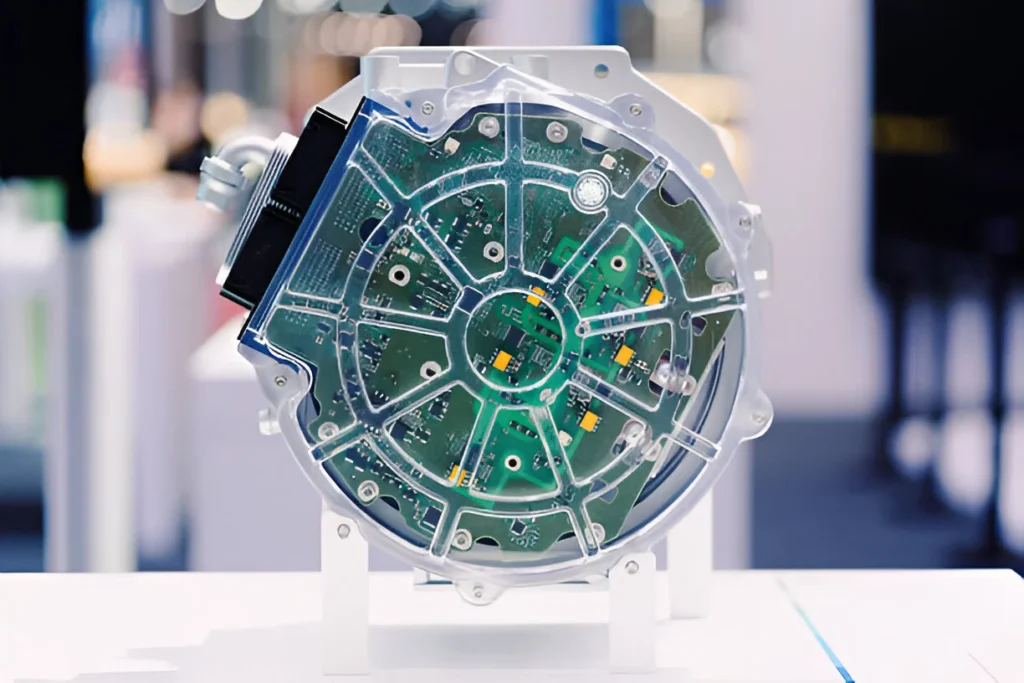
Optical Incremental Encoder High Resolution Precise Motion Feedback
An optical incremental encoder is a precision sensor used to measure rotary or linear position and speed in motion control systems. It converts mechanical motion into digital signals by detecting interruptions in a light beam through a patterned code disc.
Role in Motion Control Systems
It provides real-time feedback to controllers, enabling accurate positioning, speed regulation, and direction sensing in automated machinery, robotics, and industrial equipment.
Benefits of Optical Incremental Encoders
- High resolution: Provides precise position tracking, often hundreds to thousands of pulses per revolution (PPR).
- Reliability: Optical sensing offers stable signals with minimal drift over time.
- Cost-effectiveness: Balances performance and price, making it ideal for a wide range of industrial applications.
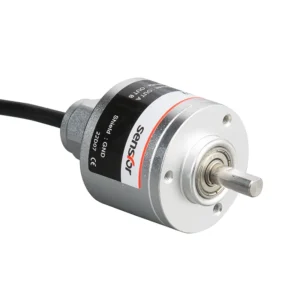
Working Principle and Core Components
| Component | Function |
|---|---|
| LED Light Source | Emits light passing through the code disc |
| Code Disc | Transparent disc with opaque patterns generating pulses |
| Photodetectors | Detect light interruptions to create electrical signals |
| Quadrature Signals A/B | Two channels out of phase to indicate direction and speed |
| Index Signal Z | Marks a reference or zero position per revolution |
The LED shines light through a transmissive optical encoder disc or reflects off a pattern in a reflective incremental encoder. Photodetectors sense light pulses to produce ABZ encoder signals, allowing for precise movement tracking.
Types of Optical Incremental Encoders
Rotary Encoders: Solid shaft or hollow shaft encoder versions available based on machinery design.
Linear Encoders: Measure straight-line motion with similar optical principles.
Advantages and Disadvantages
| Advantages | Disadvantages |
|---|---|
| High-resolution and fast response | Sensitive to dust and dirt |
| Stable and noise-resistant signals (TTL, HTL output) | Requires clean environment or sealed housing |
| Cost-effective for high-precision tasks | Can be affected by vibration if not mounted properly |
Optical vs Magnetic Incremental Encoders
| Feature | Optical Encoder | Magnetic Encoder |
|---|---|---|
| Resolution | High (up to tens of thousands PPR) | Lower (usually fewer pulses) |
| Accuracy | Superior precision | Moderate accuracy |
| Cost | Moderate | Generally less expensive |
| Operating Environment | Sensitive to contaminants | More rugged in harsh settings |
| Signal Output | Clean quadrature signals (ABZ) | Often noisier signals |
Incremental vs Absolute Encoders: Key Differences
| Aspect | Incremental Encoder | Absolute Encoder |
|---|---|---|
| Position Output | Relative pulses only | Unique position code |
| Complexity | Simple, cost-effective | More complex, pricier |
| Use Cases | Speed and position control | Critical position referencing |
Applications of Optical Incremental Encoders
- Industrial Automation: CNC machines, conveyor systems, servo motor feedback
- Robotics and AGVs: Accurate motion tracking and navigation
- Medical Equipment: Precise positioning in diagnostic and therapeutic devices
- Aerospace & Manufacturing: High-reliability position sensing for safety-critical functions
This comprehensive overview highlights how optical incremental encoders combine precision, reliability, and affordability, making them essential in modern automation and control systems worldwide.