
Quadrature vs Incremental Encoder Working Principles and Selection Guide
What Is an Incremental Encoder?
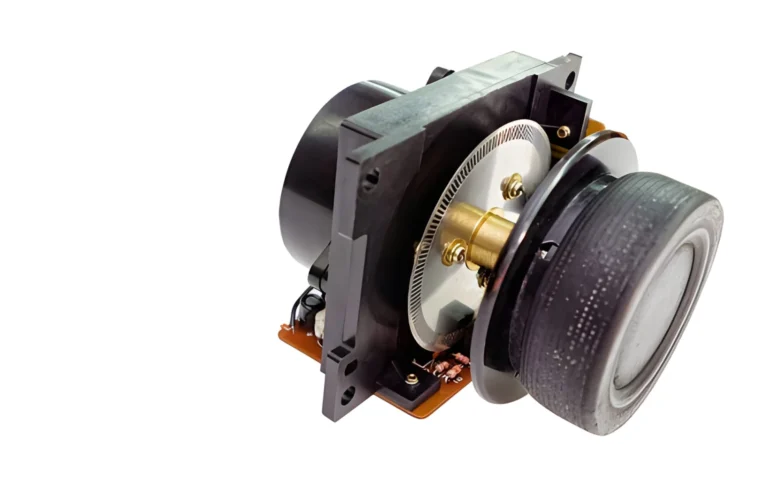
An incremental rotary encoder is a sensor that provides relative position feedback through a series of pulses. Instead of giving an exact position, it sends out electrical pulses as the shaft rotates, allowing systems to track movement, speed, and direction based on those pulses. This makes incremental encoders essential for applications requiring precise motion control without needing to know the absolute position at all times.
Basic Principle: Relative Position Feedback via Pulses
Incremental encoders generate a fixed number of pulses per revolution (PPR). Each pulse corresponds to a specific increment of movement, enabling systems to count pulses and determine how far something has moved from its starting point. However, incremental encoders require a reference point or homing procedure since they don’t retain position information after power loss.
Types of Incremental Encoders
- Optical incremental encoder: Uses an LED and photodetector to read markings on a rotating disk, offering high accuracy and resolution.
- Magnetic incremental encoder: Detects changes in magnetic fields caused by a magnetized rotor, suitable for harsh environments.
- Mechanical incremental encoder: Relies on physical contact and switches; generally less precise and more prone to wear.
Key Features
- Pulses Per Revolution (PPR): Defines the encoder’s resolution—the higher the PPR, the finer the positional increments.
- Speed and Direction Detection: By analyzing the timing and phase of pulses, the encoder can determine rotational speed and whether it’s moving forward or backward.
Common Applications
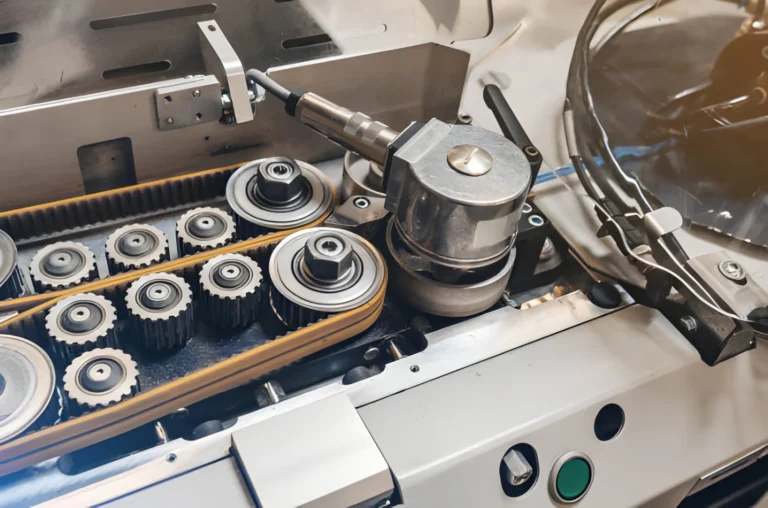
Incremental encoders are widely used for motor feedback, conveyor belt monitoring, and robotic motion control, where a cost-effective, accurate measurement of movement and speed is necessary. They fit well in industrial automation and other dynamic systems requiring fast and reliable position sensing.
Actionable Insight: When choosing an incremental encoder, consider the PPR for the resolution you need and the environmental conditions to select the appropriate encoder type—optical for precision or magnetic for durability.
What Is a Quadrature Encoder?
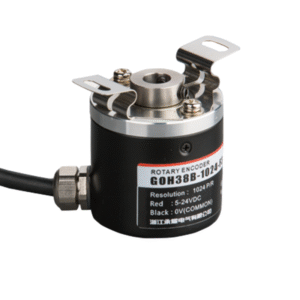
A quadrature encoder is basically a type of incremental rotary encoder that uses two output channels, usually labeled A and B, which are shifted in phase by 90 degrees. This phase difference allows the encoder not only to count pulses but also to detect the direction of rotation—whether channel A leads B or B leads A tells you if the shaft is turning forward or backward.
The typical encoder signal waveform includes the A and B channels producing square waves that are out of phase, along with an optional Z (index) pulse that signals a reference position once per revolution. This combination of signals makes quadrature encoders especially valuable for direction sensing encoder applications such as motor feedback and robotics control.
One of the main perks of quadrature output is resolution enhancement. Using different decoding modes—called x1, x2, or x4 decoding—you can multiply the pulses per revolution (PPR) by 1, 2, or 4 times respectively. This means you get finer position feedback without needing a more complex or expensive sensor setup.
For a deeper dive into how the A, B, and Z channels work and what typical waveforms look like, check out this detailed explanation on incremental rotary encoder main output signals.
Quadrature vs Incremental Encoder: Are They Different?
At first glance, the terms quadrature encoder and incremental encoder seem like two different types. In reality, quadrature encoders are a specific type of incremental rotary encoder. Here’s a straightforward breakdown:
- Incremental encoder: Provides relative position feedback by generating pulses as the shaft rotates.
- Quadrature encoder: An incremental encoder with two output channels (A and B) shifted by 90°, allowing for direction detection.
Historical context
Early incremental encoders often had just one pulse channel, which limited their ability to detect rotation direction. Over time, the quadrature output became the standard, meaning most modern incremental encoders you find today are quadrature types.
Myths debunked
- There’s no real “versus” battle here.
- Quadrature is not a competing technology; it’s an upgrade that enables bidirectional rotation sensing within incremental encoders.
Quick comparison table:
| Feature | Incremental Encoder (Single Channel) | Quadrature Encoder |
|---|---|---|
| Output Channels | 1 | 2 (A & B) + optional Z Index |
| Direction Sensing | No | Yes |
| Resolution Enhancement | Limited | x1, x2, x4 decoding modes |
| Typical Use Cases | Simple speed measurement | Motor feedback, robotics, CNC |
| Common Today? | Rare | Very common |
For more on how incremental signals translate into meaningful data, check out our detailed explanation on how to distinguish signals from incremental rotary encoders.
In short, if you’re buying an incremental encoder nowadays, you’re almost always getting a quadrature output encoder—offering better resolution and direction sensing without a significant cost increase.
Incremental (Quadrature) vs Absolute Encoders
Comparing incremental (quadrature) encoders with absolute encoders is a common question when choosing position feedback devices. Both serve to track movement, but they do it quite differently, and understanding these differences can help you pick the right solution.
Incremental Encoder Advantages
- Cost-effective: Incremental rotary encoders are generally more affordable than absolute encoders.
- High speed: They handle fast movements well, making them ideal for applications that need quick real-time feedback.
- Simple integration: These encoders are easier to interface with standard motor controllers since they output relative position pulses.
- Direction sensing: Quadrature output with A and B channels lets you detect rotation direction efficiently.
Absolute Encoder Advantages
- No homing required: Absolute encoders provide a unique position value directly, so the system always knows its position on start-up.
- Power-loss position retention: They retain position information even if power is lost—crucial for safety and precision-critical applications.
- Higher system reliability: Useful where exact positioning is mandatory without resetting or recalibration.
When to Choose Each
- Budget-conscious, high-speed needs: Go with an incremental quadrature encoder, especially if you can handle homing or zero referencing on start-up.
- Safety, precision, and zero-loss scenarios: Absolute encoders are better for robotic arms, CNC machines, and other equipment where losing position must be avoided.
Hybrid Options
Many incremental encoders now include a Z index pulse, offering a single reference position per revolution. This feature creates a “pseudo-absolute” point that helps systems find a home position quickly during initialization without the higher cost of full absolute encoders.
For more on how incremental rotary encoders work and their benefits, you can explore this detailed guide on understanding the power of incremental rotary encoders in motion control.
By weighing these factors, you can select the best encoder type for your project’s specific needs in terms of cost, performance, and reliability.
How Quadrature Encoders Work in Detail
Quadrature encoders rely on a few key internal components to provide accurate position and direction feedback. At their core, they have a code disk—usually made of glass or metal—with precise patterns. This disk spins between a pair of sensors, which can be optical (using light and photodetectors) or magnetic (using Hall effect sensors). As the disk rotates, these sensors generate two output signals, commonly called channels A and B, which are offset by 90° in phase.
This 90° phase difference in the quadrature output allows the encoder to detect direction: if channel A leads channel B, the shaft is turning one way; if B leads A, it’s the opposite. Encoders also often include a third channel, Z (or index pulse), providing a unique reference point once per revolution.
On the signal processing side, the encoder’s outputs send pulses to a controller or counter, which uses edge counting to track movement. Counting both rising and falling edges of A and B increases resolution—known as x4 decoding—effectively multiplying pulses per revolution. The use of differential encoder output helps improve noise immunity by sending signals as pairs, reducing interference in electrically noisy environments.
Quadrature encoders are available both as rotary encoders (measuring angular position) and linear quadrature encoders (measuring straight-line displacement). The basic working principle is similar, but linear encoders track movement along a path instead of around an axis.
In practical terms, the encoder’s output waveforms clearly display how pulses change with rotation direction:
- For clockwise rotation, channel A leads B.
- For counterclockwise, channel B leads A.
This makes quadrature encoders ideal for motor feedback and precise position sensing in many industries. For those interested, our detailed GLT10030B rotary encoder page outlines a popular optical incremental rotary encoder option used in these setups.
Understanding this waveform and signal relationship is key to selecting the right direction sensing encoder for your project.
Advantages and Disadvantages of Quadrature/Incremental Encoders
When choosing quadrature incremental rotary encoders, knowing their strengths and limits helps pick the right fit.
Advantages
- Lower Cost: Generally cheaper than absolute encoders.
- Higher Resolution Potential: With encoder resolution x4 decoding, you can multiply pulses per revolution (PPR) for finer position data.
- Faster Response: Quick pulse output supports high-speed motor feedback.
- Direction Sensing: Thanks to quadrature output (A and B channels), direction detection is reliable.
- Widely Available: Most modern incremental rotary encoders use quadrature signals, giving better noise immunity with differential encoder output.
Disadvantages
- Requires Homing: Position resets on power loss, needing a homing routine at startup.
- Position Loss on Interference: Electrical noise or missed pulses can cause inaccurate position data.
- Less Complex than Absolute: Cannot provide a unique position instantly on power-up without an index (Z) pulse.
Comparison with Non-Quadrature Incremental Encoders
| Feature | Quadrature Encoder | Single-Channel Incremental Encoder |
|---|---|---|
| Channels | Two (A and B), often with Z | One |
| Direction Sensing | Built-in (phase difference) | No |
| Resolution | Enhanced via x4 decoding | Lower, limited to pulse count |
| Typical Use | Motor control, robotics | Basic speed monitoring |
| Noise Immunity | Higher, differential output | Lower |
Quadrature incremental encoders clearly outperform rare single-channel incremental encoders in resolution and direction sensing, making them the preferred choice in most industrial cases.
For robust high-speed applications, consider models with optimized noise immunity and durable design like those found in sensyor’s incremental rotary encoder series.
Key Specifications to Consider When Buying an Incremental Rotary Encoder
When selecting a quadrature or incremental rotary encoder, it’s important to focus on the right specs to ensure reliable and precise feedback for your application. Here’s a quick guide to the main factors:
| Specification | What to Look For |
|---|---|
| Resolution (PPR/CPR) | Pulses per revolution (PPR) or counts per revolution (CPR) determine how detailed the position reading is. Higher PPR means finer resolution. |
| Output Type | Common output signals include TTL, HTL, and differential output. Differential outputs provide better noise immunity, ideal for industrial settings. |
| Environmental Ratings | Check IP protection (like IP65 or higher) for dust and water resistance, plus operating temperature range suitable for your environment. |
| Shaft Options | Choose between solid shaft or hollow shaft depending on mounting needs and space constraints. |
| Mounting Styles | Flange, servo, or clamping options offer flexibility for easy installation. |
| Pricing & Customization | Custom-made encoders may add cost but provide perfect fit/function. Budget accordingly for special features or environmental robustness. |
For example, sensyor offers a range of high-quality incremental rotary encoders and custom solutions designed to meet various technical and environmental requirements. You can review their wheel-type rotary encoder products or explore different output types of incremental encoders to find what fits your project.
Choosing the right specs upfront helps avoid costly replacements and ensures smooth operation in your motor feedback or automation system.
Applications of Quadrature and Incremental Encoders
Quadrature and incremental rotary encoders play a crucial role across various industries thanks to their reliable direction sensing and precise position feedback. In industrial automation, they are widely used in CNC machines and servo motors to ensure accurate motion control and smooth operation. These encoders provide the necessary pulses per revolution (PPR) for precise speed and position monitoring, making them a staple in factory automation.
In robotics and Automated Guided Vehicles (AGVs), quadrature encoders are essential for tracking wheel and motor positions. Their ability to deliver clear quadrature output signals helps robots and AGVs navigate efficiently by detecting direction and speed in real time.
The consumer and medical sectors also benefit from these encoders in precision positioning systems, such as imaging devices and laboratory automation, where high resolution and reliability are critical.
Real-world applications demonstrate how incremental encoders with quadrature output boost efficiency and accuracy in manufacturing plants. For a deeper look at these uses, check out our detailed guide on incremental rotary encoder applications in industrial automation, which highlights practical examples and benefits across different setups.
How to Select the Right Encoder for Your Project
Choosing the right encoder—whether an incremental rotary encoder with quadrature output or an absolute encoder—starts with clearly assessing your project needs. Here’s a straightforward guide:
- Determine your position feedback requirement: Do you need relative position tracking (direction sensing encoder) or absolute position information? Incremental encoders provide pulses per revolution (PPR) for relative feedback, while absolute encoders give exact position without losing track on power loss.
- Consider direction sensing: For applications where direction matters, like motor feedback, a quadrature encoder (A quad B encoder) is essential since it uses two phased channels to detect rotation direction accurately.
- Evaluate resolution needs: Higher resolution (sometimes using encoder resolution x4 decoding) means better precision but also more complex wiring and processing. Match PPR or CPR (counts per revolution) to your precision requirements.
- Factor in environmental conditions and noise: Noise immunity is key in industrial settings. Differential encoder output types help reduce errors. Don’t overlook IP ratings and operating temperature ranges for your environment.
- Set your budget early: Incremental encoders usually cost less than absolute ones, but balancing cost with performance and reliability is essential.
- Look for custom solutions: If your project demands non-standard shaft sizes, mounting styles, or special output signals, work with a trusted encoder supplier who offers custom made options to fit your exact needs.
Avoid common pitfalls like neglecting noise immunity or picking an encoder with too low resolution, which can compromise performance.
For more insight, check out our detailed guide on what is an encoder to understand the full range of options before making your decision.
Consulting with specialized suppliers ensures you get precise feedback for demanding applications without overspending or sacrificing quality.
sensyor Incremental Rotary Encoders: Reliable Solutions
sensyor offers a solid range of high-quality incremental rotary encoders and quadrature encoders designed for accuracy and durability. Whether you need an optical incremental encoder or a device with differential encoder output, sensyor provides reliable solutions tailored to various industrial needs.
Why Choose sensyor Encoders?
| Feature | Description |
|---|---|
| Custom-made options | Tailored designs to match your exact specs |
| Competitive pricing | Cost-effective without compromising quality |
| Manufacturing expertise | Years of experience ensuring precision and durability |
| Durable designs | Built for harsh environments and long service life |
| Precise feedback | Ideal for motor feedback encoder and automation |
Alongside standard models like the GOS63 rotary encoder, sensyor supports custom configurations to suit special applications, including high-resolution x4 decoding or encoders with Z index pulse for reference.
Get in Touch
For detailed specifications or custom solutions, contact sensyor today. Their expert team can guide you to the right direction sensing encoder for your project’s needs, ensuring both performance and value.
Explore sensyor’s full product lineup for your incremental rotary encoder requirements and enjoy precise, reliable position feedback in any setup.
FAQ Section
What is the main difference between quadrature and incremental encoders?
An incremental encoder provides relative position feedback through pulses, while a quadrature encoder is a type of incremental rotary encoder that uses two phased output channels (A and B) for direction sensing. Essentially, quadrature encoders are incremental encoders with enhanced features like direction detection.
Do all incremental encoders use quadrature output?
Most modern incremental encoders use quadrature output because it allows for accurate direction sensing and higher resolution through x4 decoding. However, some older or simpler incremental encoders may have a single output channel.
Incremental vs absolute: Which is better for motor control?
Incremental encoders are generally more cost-effective and ideal for high-speed motor feedback where relative positioning suffices. Absolute encoders are preferred when position retention after power loss or high precision is critical, such as in safety systems or precise automation.
How does x4 decoding improve resolution?
X4 decoding leverages both rising and falling edges of the two quadrature channels (A and B), effectively quadrupling the number of pulses counted per revolution. This results in a much finer position resolution without changing the physical pulses per revolution (PPR).
Can quadrature encoders handle high speeds?
Yes, quadrature encoders are designed to handle high speeds effectively. Their differential encoder outputs and signal edge processing provide reliable speed and direction feedback even in demanding applications. For details on robust encoder options, consider checking sensyorcoder’s incremental encoder product line.