
Incremental Encoder Types for Smarter OEM Selection
When I talk with OEM buyers, machine builders, and purchasing teams, I notice the same pattern: everyone says they need an encoder, but what they actually need is the right encoder for the motion, wiring, control logic, mounting space, and budget. That is exactly why the topic of incremental encoder types matters so much in real projects, especially when the application is tied to PLC feedback, motor speed monitoring, packaging lines, web tension systems, labeling equipment, elevators, textile machinery, and compact automation assemblies.
This is not a tiny niche, either. One market report valued the global rotary encoder market at USD 2.99 billion in 2025 and projected it to reach USD 3.26 billion in 2026, while the same report said incremental encoders held about 58% of the rotary encoder market in 2025; another report added that rotary incremental encoders accounted for about 73% of total incremental encoder market revenue in 2024. In plain English: buyers are not debating a niche component for fun; they are selecting one of the most widely used motion feedback devices in industrial automation.
If I had to say it with a smile, I would put it like this: an encoder may look small in the BOM, but it has a remarkable talent for creating very large meetings when it is chosen badly. So let us make sure that does not happen.

What Incremental Encoder Types Really Mean
When people search for incremental rotary encoders, they often expect one neat category. In reality, the market breaks down by sensing method, shaft structure, signal format, resolution, housing size, protection level, and installation method, which is why “encoder type” is never just one thing. Another reason these devices remain dominant is practical compatibility: rotary incremental encoders are widely used across servo motors, robots, and rotating machinery because they are available in many shaft sizes and work well with standard industrial drive platforms.
For a B-end buyer, I usually frame incremental encoder types in two layers. First comes the core feedback principle—how pulses are produced and read by the controller. Second comes the mechanical and electrical package—solid shaft or hollow shaft encoder, cable or connector, AB or ABZ output, open collector or line driver, and the voltage your PLC or motion card will actually accept without drama.
| Incremental encoder type | What I look at first | Typical fit in B2B projects | Purchasing reminder |
|---|---|---|---|
| Optical incremental encoder | Resolution stability, response speed, installation cleanliness | Packaging, printing, converting, precise indexing | Confirm dust, oil mist, and vibration conditions |
| Magnetic encoders | Anti-interference expectations, contamination tolerance, cost target | General automation, conveyors, motors, harsh areas | Ask for signal quality under low speed and high noise |
| Solid shaft encoder | Coupling method, shaft diameter, radial load | Conventional motor and gearbox feedback | Match shaft size and clamp style early |
| Hollow shaft encoder | Mounting convenience, compact assembly, coaxial installation | Servo motors, retrofit spaces, integrated drive systems | Confirm shaft tolerance and anti-rotation arm details |
| AB / ABZ incremental rotary encoders | Direction feedback, zero reference need | Speed, length, batching, reference positioning | Make sure the PLC high-speed input can read the output type |
This is where many sourcing conversations get unnecessarily messy. A buyer asks for an incremental encoder supplier, the supplier quotes a unit, and only later does everyone discover that one side assumed push-pull output while the other side designed around line driver, or that the shaft was hollow when the machine drawing expected solid. I wish I could say this is rare, but the industry would miss half its coffee breaks.
In practical OEM work, I check three things before I even talk about price: required pulses per revolution, output circuit, and mounting style. After that, I care about cable length, shielding, operating voltage, and whether the encoder must survive a cabinet full of inverters that hum like they are auditioning for a rock band.
If you are unsure which type of incremental encoder your project requires, please feel free to contact us.
Absolute Rotary Encoder vs Incremental Choices
The phrase absolute vs incremental rotary encoders is one of the most useful comparisons a buyer can make, because the two products solve different control problems. Absolute rotary encoders assign a unique code to each shaft position, so they can identify the shaft position directly at any given time; incremental encoders generate pulses whenever the shaft moves through a specific angle, which makes them excellent for measuring change in position, speed, and count over time rather than reporting position inherently.
That difference becomes especially important after power loss. An absolute rotary encoder can retain or immediately report the actual shaft position when power returns, while an incremental design normally relies on a reference mark, homing routine, or retained count from the control system to recover position. RealPars also notes that absolute encoders can be single-turn or multi-turn, which matters when the machine must track one revolution versus many revolutions across longer travel or more complex positioning logic.
So, which one wins? Honestly, neither wins universally. If I am reviewing an application like a filling line, conveyor synchronization system, or speed feedback loop on a motor, incremental rotary encoders are often the sensible commercial choice because the controller mainly cares about pulses, direction, and a repeatable reference. If I am looking at a rotary indexing table, tooling head, or axis that cannot afford re-homing after an outage, the case for an absolute rotary encoder becomes much stronger.
And here is the funny part: many buyers do not really want “the best encoder.” They want the least expensive encoder that will not make the maintenance manager send angry photos at 2:00 a.m. That is a perfectly reasonable business objective.
Magnetic Encoders and Hollow Shaft Reality
Now let us move from theory to selection pressure, because this is where buyers either save time or lose weekends. As the comparison sources explain, absolute encoders can use either magnetic or optical sensing methods, which reminds us that the sensing technology is not a cosmetic detail; it shapes how the encoder behaves under contamination, vibration, and integration constraints. In my own quoting work, when the plant environment includes dust, splash, or less-than-perfect alignment discipline, conversations about magnetic encoders usually become much more serious, much more quickly.
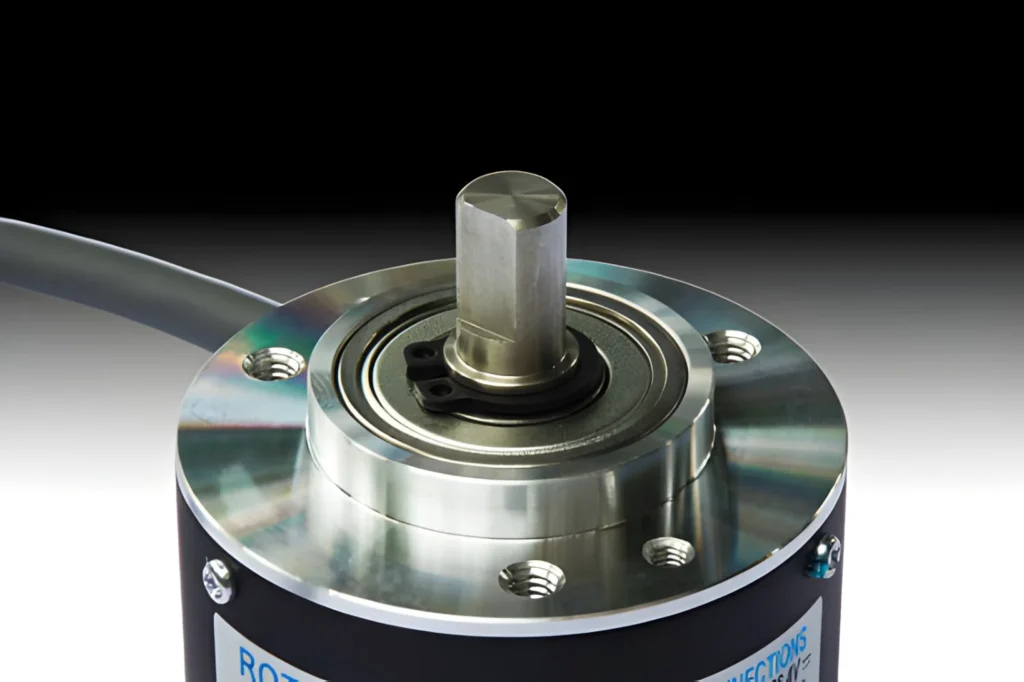
The same is true for the hollow shaft encoder category. One industry explanation describes a hollow-shaft encoder as a ring-shaped encoder with an open interior, allowing data and power cables to pass through the center of the system, and notes that such designs can use transmitter and receiver parts that rotate without contact, reducing wear compared with traditional shaft-and-bearing arrangements. That is not just an elegant design note; it directly affects maintenance intervals, retrofit feasibility, and the total installation footprint.
When I speak with an incremental encoder manufacturer or incremental encoder factory, I do not ask only for a catalog page. I ask how the unit behaves next to a VFD, how the cable shielding is arranged, whether the zero pulse is stable, whether the hollow shaft tolerance is tight enough for repeat assembly, and whether the service team can support OEM labeling or custom cable exits. That is how professional sourcing looks when it is done before the PO instead of after the complaint.
There is also a commercial angle that buyers should not ignore. A good incremental encoder supplier, incremental encoder exporter, or incremental encoder wholesaler is not only selling hardware; they are reducing mismatch risk between the encoder, the PLC high-speed counter, the motor shaft, and the field wiring. If you are buying incremental encoder wholesale for recurring builds, that support layer is often more valuable than saving a tiny amount on unit cost.
Where GOS38AO4 Fits in OEM Procurement
Let us bring the discussion closer to the product model you specified: GOS38AO4 Rotary Encoder φ38mm 10000P/R | PLC OEM Supplier. Even before I see the full drawing package, a 38 mm body and 10000 P/R positioning signal tell me this product is aimed at compact installations where the buyer wants fine feedback density without moving up to a much larger housing. In other words, this is not the kind of encoder you pick because it “looks industrial”; this is the kind you choose because the application actually needs high pulse detail.
Comparable 38 mm industrial encoders listed online commonly show compact housings, photoelectric sensing, and AB or ABZ output options around 1000 PPR, while another 38 mm industrial model advertises resolution up to 10000 P/R and highlights PLC integration, anti-interference circuitry, and long service life. That range matters because it shows where a 38 mm encoder family sits in the market: small enough for space-conscious assemblies, yet capable of much higher resolution when the control task demands it.
| OEM scenario | Why GOS38AO4 makes sense | What I would confirm before ordering |
|---|---|---|
| PLC speed and length feedback | High pulse density helps fine measurement | Input frequency limit of the PLC high-speed counter |
| Packaging or labeling machine | Compact φ38 mm body suits tighter mechanical layouts | Shaft size, cable direction, and mounting bracket space |
| Servo retrofit or motor feedback | 10000 P/R supports finer control logic | Output type, shielding, and electrical noise resistance |
| Repetitive OEM builds | Good candidate for standardized BOM selection | Stable lead time, batch consistency, and OEM marking |
| Export-focused purchasing | Easier to source as a repeatable standard item | Compliance documents, packaging, and after-sales support |
From a B2B perspective, this is where language like incremental encoder manufacturer, incremental encoder supplier, incremental encoder service, and incremental encoder China becomes commercially useful rather than merely SEO-friendly. A serious buyer wants a supplier that can hold dimensional consistency, keep output circuits stable across batches, respond to engineering changes, and support export documentation without turning every reorder into a detective novel.
If I were writing the RFQ for this model, I would not send one vague sentence saying “need encoder, high precision.” I would specify the shaft type, output form, operating voltage, cable length, PLC brand, required zero pulse, installation space, annual quantity, and whether private labeling is needed. That one extra layer of detail usually shortens quotation time, reduces back-and-forth, and makes the incremental encoder wholesaler or exporter far more accurate on the first pass. And yes, it also makes everyone look smarter in the meeting, which never hurts.
If you are unsure which type of incremental encoder your project requires, please feel free to contact us.
For buyers comparing multiple vendors, here is the commercial truth I keep repeating: the best incremental encoder factory is not always the one with the lowest sample quote. It is the one that can keep signal quality, delivery, and technical communication consistent across volume orders. If your project is moving toward sampling or mass production, sending an inquiry with complete application data is a much better shortcut than guessing from model names alone.
FAQ
Are incremental rotary encoders still mainstream?
Yes, they remain a major market category in industrial automation.
Is an absolute rotary encoder better?
Better only when true position retention matters.
Are magnetic encoders worth considering?
Very often, especially in tougher environments.
When is a hollow shaft encoder attractive?
When space, direct motor mounting, or cable routing matters.
What helps conversion on B2B inquiries?
Clear specs, yearly demand, and actual application details.