Main Type of Encoders-The Guide for Selection
In today’s world of industrial automation and smart manufacturing, encoders play an essential role. They help machines “see” position and movement, making precise control and feedback possible. Whether it’s a robot, CNC machine, or automated production line, encoders are key sensor devices.
As a professional encoder supplier, we understand that every customer has unique needs. Choosing the right type of encoder directly impacts your equipment’s performance and reliability. This article will introduce the main types of encoders, helping you quickly understand their features and applications, so your B2B selection process is more scientific and efficient.
Encoder Classification Methods
There are many types of encoders, and they can be categorized in several ways. Understanding these categories helps you quickly find the right product.
By Motion Type
- Rotary Encoder
- Linear Encoder
By Output Signal
- Incremental Encoder
- Absolute Encoder
By Sensing Technology
- Optical Encoder
- Magnetic Encoder
- Inductive/Capacitive/Resolver Encoder
These categories not only help you understand how encoders work but also make it easier to choose based on your needs.
Detailed Overview of Main Encoder Types
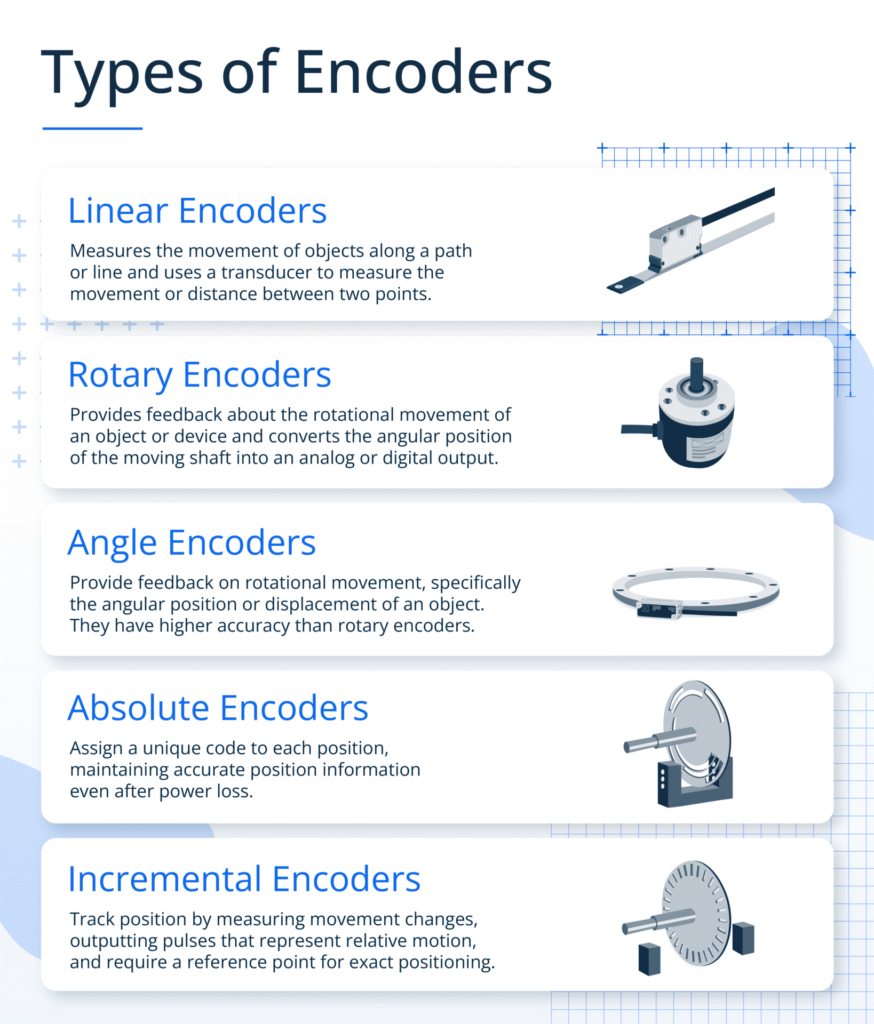
1. Rotary Encoder
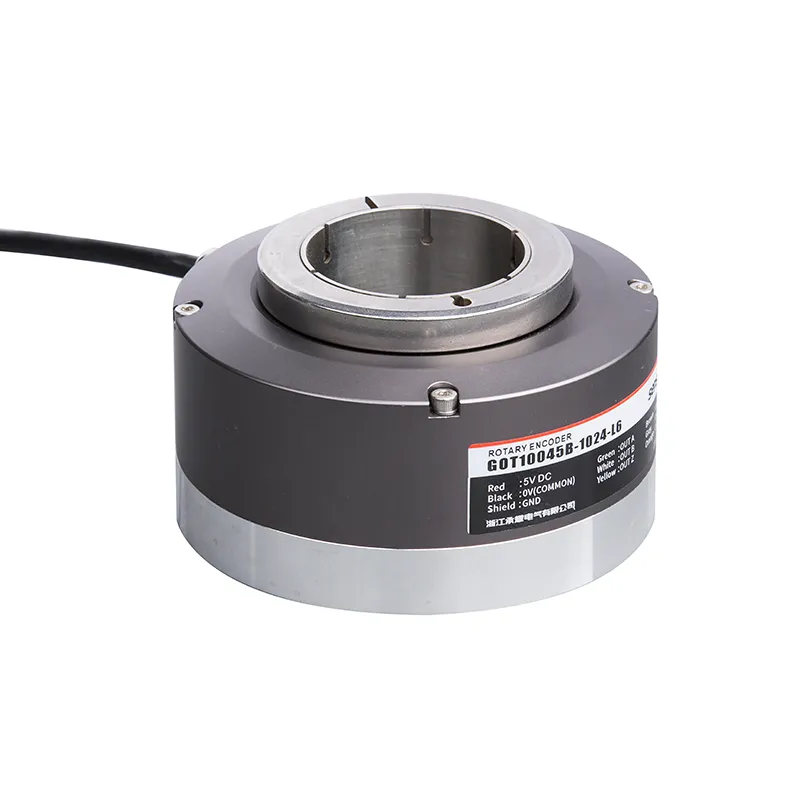
Rotary encoders are the most common type. They measure the rotation angle or speed of a shaft and are widely used in robotic joints, automation devices, and motor control.
- Incremental Rotary Encoder: Outputs pulse signals; position changes are determined by counting pulses. Ideal for applications needing speed and direction feedback.
- Absolute Rotary Encoder: Each position has a unique code, and position data is retained even after power loss. Perfect for high-precision and safety-critical uses.
2. Linear Encoder
Linear encoders measure straight-line displacement. They’re commonly found in CNC machines and measuring instruments, providing high-precision position feedback to ensure processing accuracy.
3. Incremental Encoder
Incremental encoders output pulses to reflect position changes. They have a simple structure and lower cost, but position data is lost when powered off. They suit cost-sensitive applications where real-time compensation is possible.
4. Absolute Encoder
Absolute encoders provide unique position information, which is not lost during power outages. They are ideal for industrial environments that require power-off protection and high reliability. Single-turn and multi-turn versions are available for different measurement ranges.
5. Optical Encoder
Optical encoders use optical sensing technology. They offer high accuracy and resolution but are sensitive to dust and vibration. They’re best for clean environments and high-precision requirements.
6. Magnetic Encoder
Magnetic encoders detect position changes via magnetic fields. They have strong anti-interference capabilities, making them suitable for harsh environments with high temperatures, dust, or vibration.
7. Inductive/Capacitive/Resolver Encoder
These encoders have a complex structure and are suitable for extreme environments with strong anti-interference features. They’re often used in aerospace, heavy machinery, and other specialized industries.
Comparison Table of Common Encoder Types
| Encoder Type | Accuracy | Environmental Adaptability | Cost | Maintenance | Typical Applications |
|---|---|---|---|---|---|
| Optical Encoder | High | Average | Medium-High | Medium | High-precision machinery, robotics |
| Magnetic Encoder | Medium | Strong | Medium | Low | Harsh environments, industrial automation |
| Incremental Encoder | Medium | Average | Low | Low | Speed feedback, general automation |
| Absolute Encoder | High | Strong | High | Medium | Power-off protection, high-reliability uses |
| Linear Encoder | High | Average | Medium-High | Medium | CNC machines, measuring instruments |
| Inductive/Resolver Encoder | Medium-High | Very Strong | High | High | Aerospace, heavy machinery |
How to Choose the Right Encoder for Your B2B Project?
Don’t just look at the price when choosing an encoder! Ask yourself a few questions first:
- Are you measuring rotation or linear movement?
- What level of accuracy do you need?
- What’s the environment like? Is it dusty or hot?
- Do you need to keep position data after a power outage?
- What’s your budget?
With these questions in mind, you can narrow down your options. For example:
- Need high accuracy and position retention after power loss? Choose an absolute optical encoder.
- Facing harsh environments with a limited budget? A magnetic incremental encoder is a great choice.
- Only need speed feedback and want to save costs? An incremental rotary encoder fits the bill.
Also, consider interface compatibility, resolution, installation method, and customization options. Our factory offers a wide range of encoder products and custom solutions—feel free to contact us for expert advice!
Choosing the right encoder is key to ensuring equipment performance and production efficiency. Understanding the main types and features of encoders helps your B2B project avoid detours and boosts your overall competitiveness.
If you’re looking for high-quality, reliable encoders, visit our website or contact us directly. Our professional team will tailor the most suitable solution for you and help upgrade your industrial automation!
FAQ
What are common encoder failures?
Common issues include signal loss, position drift, and mechanical wear. Regular maintenance and choosing the right encoder for your environment can greatly reduce failure rates.
How do I choose between incremental and absolute encoders?
If you need to retain position after power loss, absolute encoders are best. Incremental encoders are suitable for real-time monitoring and cost-sensitive applications.
What’s the difference between encoders and other position sensors?
Encoders output digital signals directly, offering high precision and fast response—ideal for dynamic control. Other sensors, like potentiometers, are more for simple position detection.