In the world of industrial automation, precise timing isn’t a luxury—it’s a necessity. Whether you’re designing a high-speed data acquisition system, calibrating RF modules, or managing test instrumentation, the CY7 High-Frequency Counter provides the accuracy and stability your project demands.
Let’s dive deep into how this device works, where it excels, and why manufacturers and engineers worldwide rely on it for their most demanding measurement applications.
What Is the CY7 High-Frequency Counter?
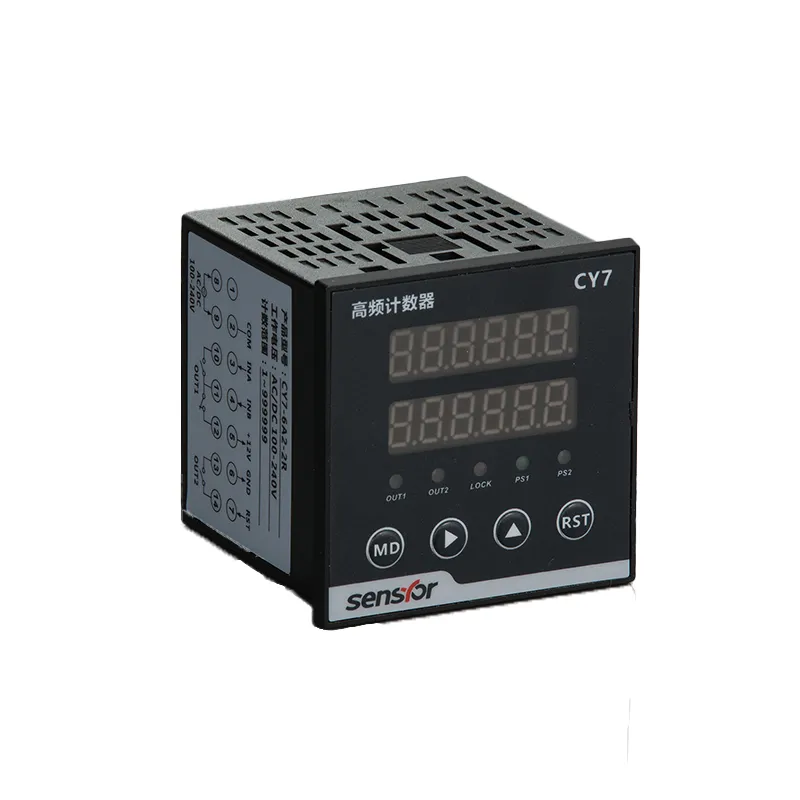
The CY7 High-Frequency Counter is a high-performance timing device designed to measure rapid pulse frequencies with exceptional resolution and stability. It’s engineered for industrial testing environments, embedded systems, and precision instrumentation, where accurate signal measurement is key to performance and safety.
In simple terms, think of it as the “heart monitor” of your circuit—it counts how many signal pulses occur in a given time, translating them into a frequency reading that can be used for calibration, diagnostics, or control feedback.
Typical application areas include:
Telecommunications (e.g., clock synchronization, frequency monitoring)
Automation equipment (PLC test benches, motion control systems)
Here’s a quick overview of the CY7’s technical capabilities that make it stand out:
Parameter
Specification
Frequency Range
Up to 2.4 GHz
Resolution
10-digit accuracy (depending on gate time)
Input Sensitivity
50 mV to 5 V RMS
Input Impedance
50 Ω / 1 MΩ switchable
Measurement Functions
Frequency, Period, Time Interval, Pulse Width
Interface Options
USB, RS-232, and Ethernet
Display Type
High-contrast TFT with digital readout
Calibration
Available with NIST traceable certificate
Operating Temperature
0°C to 50°C
These high-end specifications make the CY7 comparable to professional-grade frequency counters used in aerospace, defense, and manufacturing R&D labs.
Why Engineers Prefer the CY7 High-Frequency Counter
Ever wondered why professional engineers switch to CY7 for production lines or lab setups? It’s not just precision—it’s efficiency, reliability, and support. Let’s take a closer look:
1. Ultra-High Stability: With a temperature-compensated crystal oscillator (TCXO), the CY7 maintains consistency even in fluctuating environments. That means fewer recalibrations and more uptime.
2. Flexible Integration: Engineers can easily integrate it into automation setups using standard industrial protocols. Its Ethernet and USB connectivity make remote monitoring and data acquisition straightforward.
3. Long-Term Reliability: For B2B buyers and OEMs, long-term product supply and aftersales support are critical. The CY7 is backed by extended warranties and local calibration service options.
4. Cost-Efficiency for Procurement Teams: When compared to alternatives from brands like Keysight or Tektronix, the CY7 offers a strong price-to-performance ratio, making it an appealing choice for large-scale manufacturing projects.
Applications in Modern Industry
The CY7 isn’t just versatile—it’s designed for a wide range of real-world projects.
Industry
Typical Use Case
Automotive Electronics
ECU signal calibration, sensor testing
Telecommunications
Frequency stability monitoring, RF oscillator calibration
Because of its wide frequency bandwidth and digital connectivity, the CY7 integrates well into automation dashboards and data acquisition software—reducing manual measurement errors and speeding up production validation cycles.
If your project requires a CY7 High-Frequency Counter, we are ready to provide you with a quick quote and free technical consultation.
Choosing the right frequency counter is more than just comparing price tags. Below is a simplified comparison of the CY7 High-Frequency Counter versus common alternatives:
Feature
CY7
Competitor A
Competitor B
Frequency Range
Up to 2.4 GHz
1.5 GHz
2.0 GHz
Resolution
10 digits
8 digits
9 digits
Connectivity
USB / Ethernet / RS-232
USB only
Ethernet only
Calibration Option
NIST traceable
Available separately
Available separately
Best For
High-speed, industrial measurement
General lab testing
R&D only
This comparison shows that the CY7 merges technical capability with business-friendly value—a major win for OEM engineers and industrial buyers alike.
How to Choose the Right High-Frequency Counter
If your project involves high-speed measurements or controlled timing loops, here’s what you should evaluate before ordering:
Frequency Range – Ensure the counter matches or exceeds your signal’s max frequency.
Accuracy and Stability – Look for TCXO or oven-controlled oscillators (OCXO) for better timing.
Connectivity Options – Consider Ethernet for remote setups or RS-232 for legacy equipment.
Calibrations and Certifications – Check for NIST or ISO calibrations if your process requires traceable accuracy.
Supplier Support – Pick vendors offering on-site technical assistance and aftersales support.
When in doubt, talk to a technical sales engineer—they can help match your exact requirements. (Need a quotation or technical datasheet? [Contact our engineering team today to request a sample or RFQ.])
Installation and Maintenance Tips
Once your counter arrives, setup is straightforward—but a few best practices can maximize accuracy:
Always allow 15–30 minutes of warm-up time before measurements.
Use 50 Ω coaxial cables for high-frequency inputs.
Periodically calibrate your unit to maintain measurement confidence.
Protect the device from high humidity or static discharge.
Maintaining these steps ensures long-term reliability and consistent readings—especially important in compliance-sensitive sectors.
For engineers, buyers, and technical procurement teams, the CY7 High-Frequency Counter is more than just a measurement tool—it’s an investment in precision and reliability. Its blend of high performance, scalable connectivity, and calibration-ready design makes it one of the most practical options for B2B industrial measurement systems today.
If your project demands fast, accurate, and traceable frequency measurement, the CY7 deserves a place on your shortlist. Whether you need one for the lab or hundreds for your production line, our support team is ready to help you get a fast quote and free technical consultation.
FAQ
What is the input channel configuration for CY7?
The CY7 typically features two high-sensitivity input channels (A and B) for simultaneous or ratio measurements.
Can CY7 High-Frequency Counter be controlled via software?
Yes. The counter supports PC control through USB, RS-232, or Ethernet, and includes an SDK for automation integration.
Is calibration service available globally?
Absolutely. CY7 calibration can be performed locally through authorized partners or with a NIST-traceable option at the factory.
What kind of frequency accuracy can I expect?
Depending on the gate time and oscillator type, typical accuracy is within ±0.001 ppm for standard models.
Does CY7 support custom firmware or OEM integration?
Yes. OEM partners can request firmware customization, including additional measurement functions or protocol support.
Table of Contents
If your project requires a CY7 High-Frequency Counter, we are ready to provide you with a quick quote and free technical consultation.
Sensyor Draw Wire Encoder – Reliable Linear Position Feedback with Spring-Loaded Cable Mechanism Featuring the Sensyor draw wire encoder in action, this precise linear cable encoder delivers outstanding accuracy and durability for demanding industrial applications. Engineered with a robust spring-loaded cable mechanism, it ensures consistent position feedback over a wide measuring range without compromise. Core […]
How do you choose the right absolute linear encoders for CNC or automation? The short answer: match the encoder’s measuring principle, resolution, interface, and mechanical design to your machine accuracy, environment, and budget—and make sure it integrates smoothly with your existing CNC or PLC controller. When you get those four points right, an absolute linear […]
Discover high-precision incremental linear encoders with optical and magnetic types offering reliable position feedback for industrial automation and CNC systems
We use cookies to enhance your browsing experience, serve personalised ads or content, and analyse our traffic. By clicking "Accept All", you consent to our use of cookies.