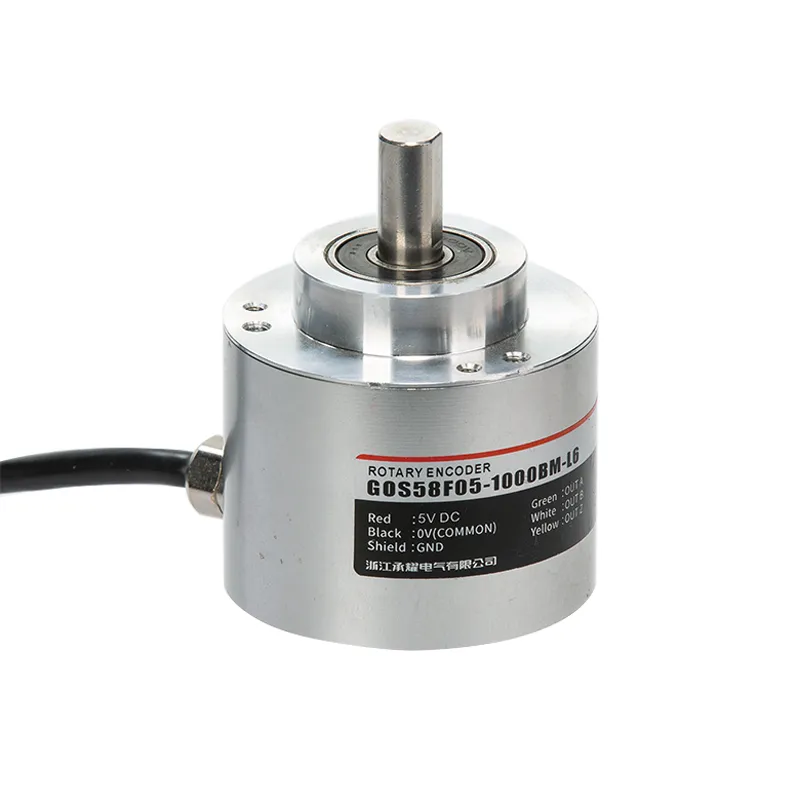
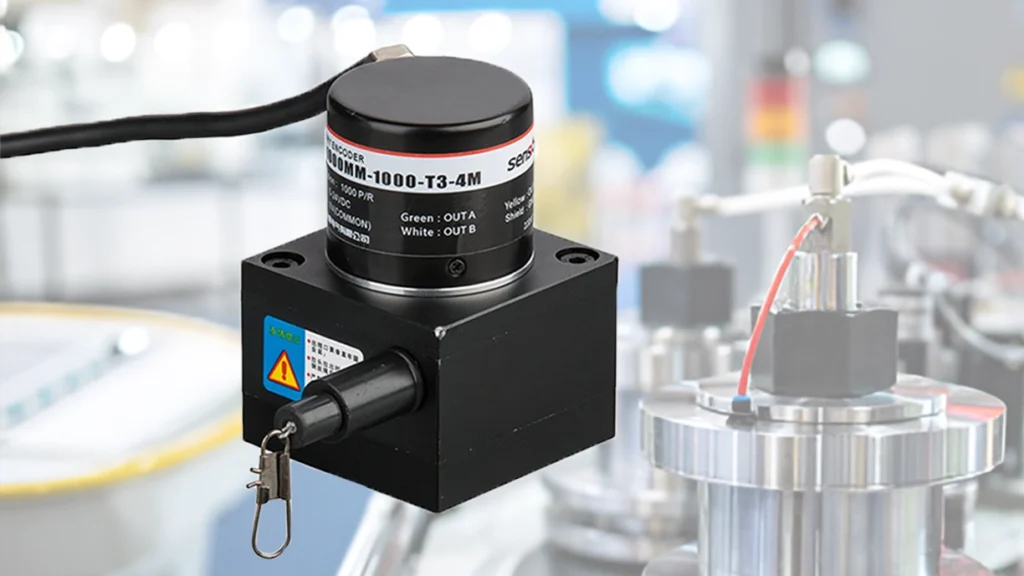
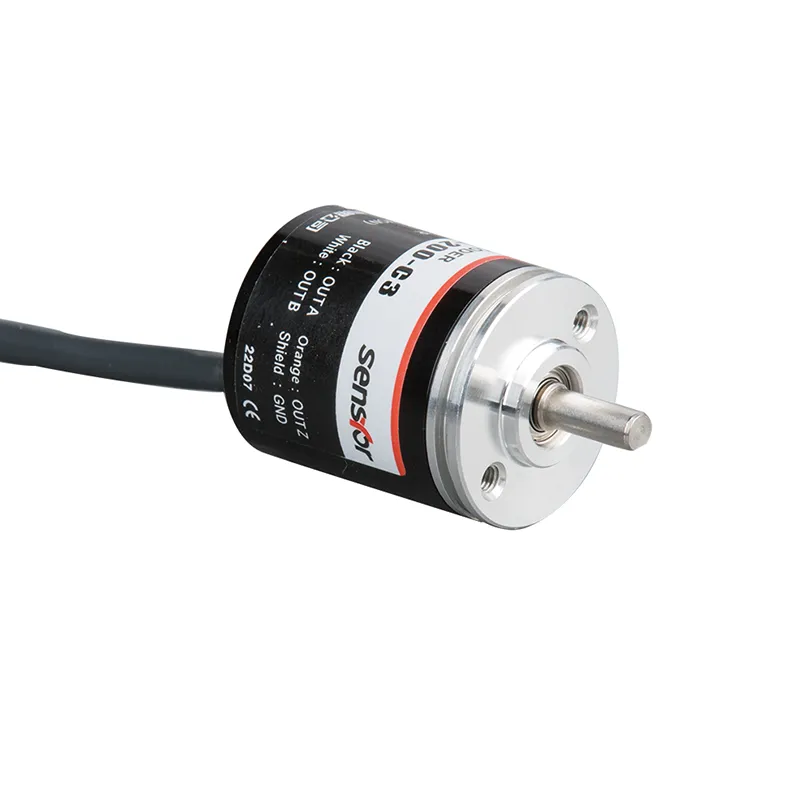
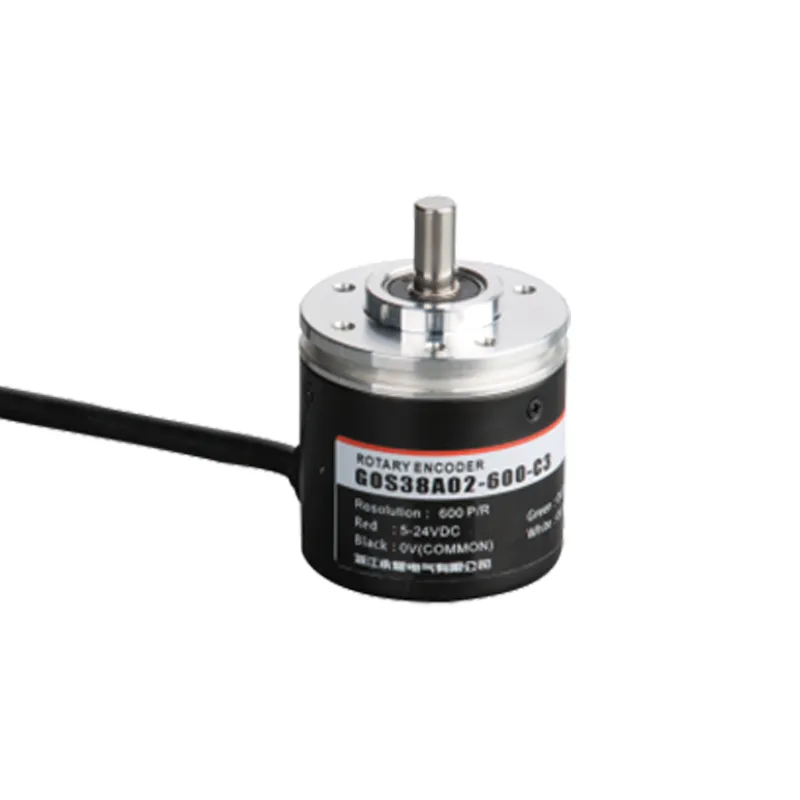
The Sensyor incremental rotary encoder is a precision sensor designed for accurate relative position tracking and direction detection in industrial and automation applications. Featuring quadrature output signals, this incremental shaft encoder provides reliable speed and position feedback, making it a cost-effective solution for motor control, robotics, CNC machinery, and more.
Key benefits include:
High accuracy in relative position measurement
Direction sensing via quadrature A/B channels
Versatile and cost-efficient speed and position feedback
What sets Sensyor incremental rotary encoders apart is their superior durability with rugged aluminum or stainless steel housings, flexible resolution options ranging from 100 to 10,000 pulses per revolution (PPR), and straightforward integration with various output interfaces and controllers.Explore our models today—request a quote or view available product options to find the ideal encoder for your application.
Key Features and Benefits of Sensyor Incremental Rotary Encoder
Our incremental rotary encoders deliver reliable quadrature output with A and B channels to detect rotation direction, plus an optional Z (index) pulse for precise reference points. They offer versatile resolutions from 100 up to 10,000 pulses per revolution (PPR/CPR), fitting both simple and high-precision applications.
Feature
Benefit
Optical or Magnetic Sensors
Flexibility for different environments and durability needs.
Shaft Types
Solid shaft, hollow bore, and blind hollow bore options to fit your mechanical setup.
Output Interfaces
TTL, line driver (differential), open collector, push-pull for easy integration.
Supply Voltage Range
Works with 5-30 VDC systems, adaptable to various controls.
High-Speed Operation
Low latency signals ensure fast, accurate feedback.
Robust Housing
Aluminum or stainless steel with sealed bearings for long service life in harsh conditions.
This combination of features makes Sensyor’s incremental shaft encoder ideal for everything from industrial motor feedback to detailed position tracking in CNC machines. For more about our encoder range, check our Glt10045b rotary encoder or the Gos58b05 rotary encoder for specialized models.
Technical Specifications of Sensyor Incremental Rotary Encoder
Sensyor incremental rotary encoders come with a versatile set of technical specs designed for reliability and precision across global industrial applications. Here’s a quick breakdown:
IP64, IP65, and IP67 options for dust/water resistance
Operating Temp.
-20°C to +85°C standard; extended ranges available
Electrical Specs
Supply voltage 5-30 VDC; low current draw; signal levels TTL, line driver, open collector, push-pull
Mechanical Specs
Aluminum or stainless steel housing; shaft load ratings ensuring durability
Compliance
RoHS, CE certified with adherence to industry standards
These specifications make Sensyor incremental rotary encoders well-suited for industrial rotary encoder roles including motor feedback, position and speed control in demanding environments. For precise industrial uses, check out models such as the Sensyor GOS38B Rotary Encoder or explore the differences between incremental and absolute encoders for better system integration.
How It Works: Incremental Rotary Encoder Explained
An incremental rotary encoder generates a series of electrical pulses as its shaft turns. Each pulse corresponds to a small movement, allowing you to track the relative position and speed of a rotating shaft. This pulse count helps devices like motors and controllers understand how far and how fast something is moving.
Key Principles of Incremental Encoding
Pulses Per Revolution (PPR): The encoder produces a fixed number of pulses during each full turn of the shaft. Higher PPR means more precise measurement.
Quadrature Output: Two channels, A and B, output pulses with a 90° phase difference. This phase shift allows the system to detect rotation direction and increase resolution by counting rising and falling edges of both channels.
Index (Z) Pulse: An optional third channel sends a single pulse once per revolution, acting as a reference mark to reset position counting.
Incremental vs. Absolute Encoders
Feature
Incremental Encoder
Absolute Encoder
Position Output
Relative position via pulse counting
Exact position value (absolute angle)
Reference Needed
Yes, requires power-on origin reset
No, always provides actual position
Use Case
Speed control, relative positioning
Position tracking needing no reset
Incremental encoders only tell you how much you’ve moved from a start point. That’s why they need a reference pulse or external signal to track absolute position after power cycles.
Signal Timing Example
Time
Channel A
Channel B
Z Pulse
0 ms
LOW
LOW
LOW
X ms
HIGH (rising edge)
LOW
LOW
X+Y ms
HIGH
HIGH (rising edge)
LOW
Once per rev
—
—
HIGH (single pulse)
Channels A and B pulse alternately with a precise phase difference, allowing direction detection. The Z pulse acts as a unique reference once per revolution.
Integration Tips
Connect A, B, and Z outputs to microcontrollers, PLC inputs, or counters designed to handle quadrature signals.
Use interrupt routines or dedicated hardware counters for accurate pulse counting.
Be mindful of signal noise; proper shielding and grounding improve signal integrity.
For practical uses, our incremental shaft encoders integrate smoothly with industrial controllers and DIY microcontroller projects, offering dependable feedback you can count on. See detailed specs and wiring recommendations in our incremental shaft encoder product page.
Applications of Incremental Rotary Encoders
Incremental rotary encoders are essential in various fields where precise motion feedback is critical. Here’s where they make a difference:
Industrial Automation and Robotics: Used extensively for motor feedback and servo control, these encoders deliver accurate relative position tracking and direction sensing to keep automated systems running smoothly.
CNC Machinery and Machine Tools: They help with precise positioning and velocity control, ensuring high-quality machining and repeatable results.
Conveyor Systems, Elevators, and Material Handling: Incremental shaft encoders provide reliable speed and position feedback to manage and monitor material flow efficiently.
Packaging Equipment and Printing Presses: These encoders support synchronized motion control for complex packaging lines and printing operations.
Mobile Machinery and Heavy Equipment: Durable and robust, magnetic incremental rotary encoders withstand harsh environments while maintaining accurate feedback.
DIY and Hobby Projects: Popular with makers and engineers for Arduino-based controls and custom robotics due to their easy integration and reliable quadrature output signals.
By choosing the right encoder for your application, whether optical or magnetic, solid or hollow shaft, you’ll gain precise motion control tailored to your needs.
Available Models / Product Variants of Sensyor Incremental Rotary Encoders
Sensyor offers a versatile range of incremental rotary encoders to match different application needs. Our product lineup is divided into three main series:
Standard Series: Reliable, cost-effective incremental shaft encoders perfect for general automation and motor feedback tasks.
Heavy-Duty Series: Built for tough environments, featuring robust housings and enhanced sealing for industrial-grade durability.
Compact Series: Space-saving rotary quadrature encoders designed for tight installations without sacrificing performance.
Here’s a quick comparison of key Sensyor incremental rotary encoder models:
Model Name
Resolution Range (PPR)
Shaft Type
Output Type
IP Rating
Typical Use
Sensyor STD-38
100 – 5,000
Solid shaft
TTL, Line driver
IP65
Industrial automation, motor feedback
Sensyor HD-38
250 – 10,000
Hollow bore, solid
Push-pull, Open collector
IP67
Heavy machinery, harsh environments
Sensyor CMP-03
100 – 1,000
Blind hollow bore
TTL
IP64
Compact machines, robotics
All models come with flexible options for optical or magnetic sensing, tailoring the encoder to your setup. Plus, we can accommodate custom resolutions, different connector types, and cable lengths for seamless integration.
For specific coupling needs, check out our reliable Sensyor coupling series, designed to enhance shaft connection and rotary encoder performance.
No matter your industry, Sensyor incremental rotary encoders provide the right fit with durable designs and exacting precision to keep your equipment running smoothly.
Installation and Mounting Guide for Incremental Rotary Encoders
Proper installation is key to getting the best performance from your Sensyor incremental rotary encoder. Here are some simple tips to ensure smooth setup and reliable operation:
Shaft Coupling Recommendations
Use flexible couplings to connect the encoder shaft to your motor or machinery shaft. This helps absorb misalignment and prevents damage.
Avoid rigid couplings unless shafts are perfectly aligned to reduce wear on bearings and improve longevity.
For hollow bore shaft encoders, make sure shaft keys or set screws are securely tightened.
Mounting Options
Face Mount: Ideal for compact spaces, attach the encoder directly to the mounting surface using the front flange.
Servo Mount: Provides secure mounting with added stability, perfect for high-speed rotary applications.
Foot Mount: Use for applications requiring strong base support and minimal lateral movement.
Wiring Diagrams for Common Outputs
For TTL output, connect the A, B, and Z channels to your controller or drive input, along with power and ground. Shielding is important to maintain signal integrity.
For line driver (differential) output, wire the complementary pairs (A/A’, B/B’, Z/Z’) to differential inputs on your control system for noise-resistant signals.
Best Practices for Alignment and Shielding
Carefully align the encoder shaft to the driven shaft, minimizing axial and radial runout to avoid premature bearing wear.
Use shielded cable for wiring and connect shields to the system ground to reduce electrical noise and interference.
Route cables away from high-power wiring and noisy equipment to maintain clean signal transmission.
Choosing the right incremental rotary encoder is crucial for accurate and reliable position feedback. Sensyor stands out with its precision engineering that ensures a long service life even in harsh industrial settings. Our incremental shaft encoders are built to perform consistently, giving you confidence in your motor feedback and control systems.
Key Benefits
Details
Precision Engineering
High-quality components for accuracy and durability
Competitive Pricing
High performance without breaking the budget
Reliable Supply
Steady availability to meet production demands
Technical Support
Expert assistance for smooth integration and troubleshooting
Tough Environments
Proven performance in heavy-duty and industrial conditions
With a wide range of options, from optical incremental encoders to durable magnetic incremental rotary encoders, Sensyor offers solutions tailored to your application. Our products combine superior durability with easy integration, supporting various output types like quadrature outputs (A/B/Z channels) and multiple shaft designs.
Sensyor’s commitment to reliability and cost-effectiveness makes us the ideal partner for your next project in industrial automation, CNC machinery, or DIY motor feedback systems.
Accessories and Related Products
Enhance your incremental rotary encoder setup with a range of essential accessories designed for optimal performance and easy installation. We offer mounting brackets, couplings, and cables tailored to fit various shaft types, ensuring secure and precise encoder placement.For seamless signal management, choose from our signal conditioners or converters that help stabilize outputs and match different interface requirements, boosting reliability in noisy industrial environments.
Complement your incremental shaft encoder with absolute encoders or linear encoders from our catalog for applications needing absolute position reference or linear measurement. These options provide a broader scope for automation and control solutions.Explore these accessories to maximize your rotary quadrature encoder’s efficiency and integration flexibility, all backed by Sensyor’s trusted quality.
FAQ about Incremental Rotary Encoders
What is the difference between incremental and absolute rotary encoders?
Incremental rotary encoders provide pulses that track relative position changes, useful for detecting movement and direction but require a reference point to determine a starting position. Absolute encoders, in contrast, output a unique position code at every angle, retaining position info even after power loss. Learn more about incremental vs absolute encoders.
How do I determine the required resolution for my encoder?
Choose the resolution based on the precision your application demands. Higher pulses per revolution (PPR) deliver finer position detail but may increase data processing needs. For guide on resolution options, see our explanation of what PPR means in an incremental rotary encoder.
Does an incremental rotary encoder retain position after power loss?
No, incremental rotary encoders do not store position after power is cut since they track changes relative to a reference point. On restart, the system must re-establish a zero or home position using the index pulse (Z channel) or an external sensor.
Are incremental rotary encoders compatible with Arduino or PLC systems?
Yes, incremental shaft encoders with standard quadrature outputs (A, B, and optional Z channels) are easily interfaced with microcontrollers like Arduino and PLCs for speed and direction feedback.
What are common troubleshooting tips for missing pulses or incorrect direction?
Check wiring and connector integrity.
Verify correct phasing of A and B quadrature signals.
Ensure proper grounding and shielding to minimize electrical noise.
Confirm supply voltage and signal compatibility with your controller.
Downloads and Resources for Incremental Rotary Encoder
Get all the essential materials you need for your Sensyor incremental rotary encoder in one place. Access detailed datasheets (PDF) covering technical specifications and performance data to help you select the right encoder for your project. Download accurate 2D and 3D CAD models to streamline your design and integration process.
We also provide clear wiring guides and application notes that show how to connect quadrature output sensors, including A/B/Z signals, to your controllers or PLCs. Plus, find our declaration of conformity documents ensuring compliance with industry standards like RoHS and CE.
These resources make it easy to understand, install, and maintain your incremental shaft encoder efficiently. For deeper insights into incremental rotary encoders and their applications, check out our comprehensive guides on what is an incremental rotary encoder and how rotary encoders work.
Contact Us for Sensyor Incremental Rotary Encoders
Ready to find the perfect incremental rotary encoder for your project? Request a quote or sample today to experience the accuracy and reliability of Sensyor’s rotary quadrature encoders.If you have technical questions or need help selecting the right incremental shaft encoder, our knowledgeable sales engineers are here to assist you. Reach out via live chat or submit a quick form to get personalized support fast.
Explore the benefits of our high-resolution incremental encoders and discuss customization options to fit your application precisely.For direct assistance, visit our contact page and connect with Sensyor experts who understand industrial rotary encoder needs inside and out.
Have you ever wondered how machines know their exact position in space? That’s where the linear encoder steps in. Whether it’s in CNC machines, automated production lines, or robotics, linear encoders play an indispensable role. They are measuring devices that convert an object’s linear movement into electronic signals, enabling precise position monitoring and control. In this article, […]
Did you know that linear encoder are the “invisible heroes” in modern industrial automation and precision measurement? Whether in CNC machines, automated assembly lines, or high-precision measuring instruments, linear encoders play a crucial role. They help machines “see clearly,” precisely feed back positions, and ensure every step in the process is accurate. In this article, […]
Precision. Efficiency. Control. These are the promises that modern automation demands. And behind many of these advancements lies a small but incredibly important device — the linear encoder. If your business involves CNC machining, robotics, semiconductor manufacturing, or any system requiring accurate linear motion, understanding how a linear encoder works — and choosing the right one […]
We use cookies to enhance your browsing experience, serve personalised ads or content, and analyse our traffic. By clicking "Accept All", you consent to our use of cookies.