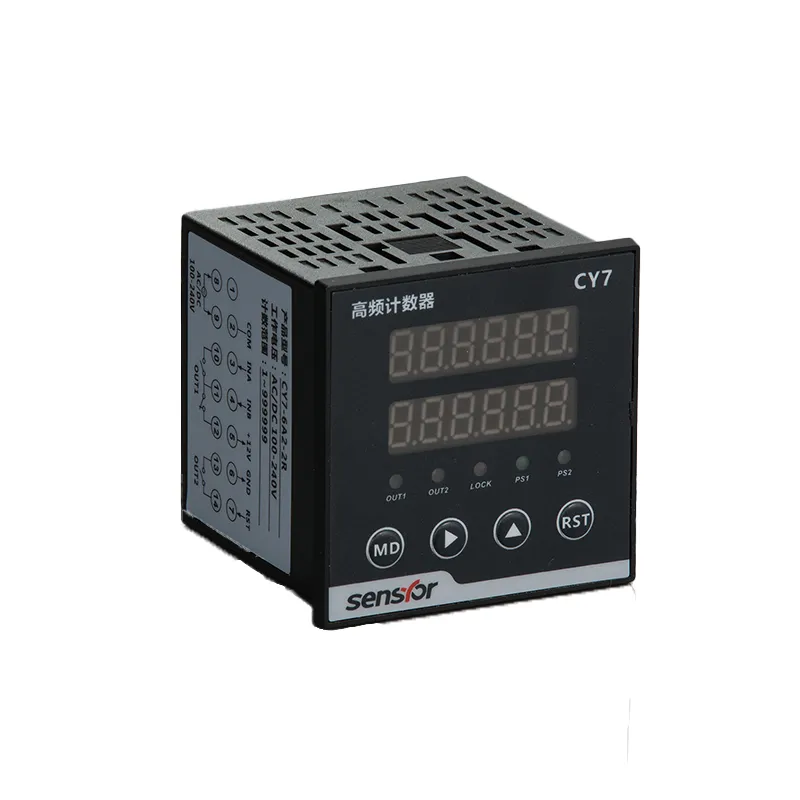
When working with CY7 High Frequency Counter measurement systems, precision is everything. If your project involves signal monitoring, industrial automation, or precision testing, you’ve likely come across the CY7 High Frequency Counter. Yet one question keeps popping up among engineers and OEM buyers alike: What is the input channel configuration for CY7 High-Frequency Counter, and how can it optimize system performance?
In this blog, we’ll unpack that question in detail—exploring input channels, connectivity options, and configuration best practices—so you can make confident decisions about integrating the CY7 into your project or production line.
Why Input Channel Configuration Matters
Before diving into the CY7 specifics, let’s step back and consider why input channel configuration is such a crucial factor in high-frequency counting.
In essence, the input channels of a frequency counter determine how signals are captured, filtered, and processed. Differences in channel impedance, amplitude range, and isolation can dramatically impact both accuracy and stability. For high-speed applications—say, above 100 MHz—even a slight mismatch can cause timing jitter or miscounts.
For procurement teams, that means you’re not just buying a counter—you’re investing in measurement integrity. The CY7 High Frequency Counter provides a modular input design that adapts easily to various signal environments, making it ideal for industries such as:
Now, let’s get specific. The CY7 High Frequency Counter typically ships with two primary input channels (CH1 and CH2) and an optional reference channel, each designed for high-speed accuracy and flexible integration into different test setups.
Channel Type
Typical Frequency Range
Input Impedance
Coupling Options
Application Use Case
CH1
DC–500 MHz
50 Ω / 1 MΩ switchable
AC / DC
General frequency measurement
CH2
1 Hz–250 MHz
1 MΩ
DC
Low-frequency precision counting
REF IN / EXT REF
Up to 10 MHz
50 Ω
AC
External reference synchronization
This configuration gives engineers both flexibility and redundancy—ideal when switching between analog, TTL, and CMOS signal sources without needing external conditioning circuits.
Signal Compatibility and Scaling Options
The CY7 High Frequency Counter design philosophy revolves around universality. That means it doesn’t confine engineers to one signal type. Whether you’re measuring square waves, pulse trains, or modulated carriers, the input amplifiers handle a wide dynamic range.
The counter supports signal levels as low as 20 mV RMS, scaling automatically to prevent saturation or noise distortion. This is particularly helpful in multi-channel testing environments, where signal strength can vary widely.
If you work in RF design or need to count high-frequency clock edges for embedded systems, this adaptability is invaluable. Plus, the auto-scaling input reduces downtime during configuration swaps—no need to stop the test bench to recalibrate thresholds manually.
Configuring and Calibrating Channels
While the CY7 High Frequency Counter offers plug-and-play simplicity, advanced users often fine-tune the input configuration to match their specific testing protocols.
A typical process looks like this:
Select the active channel using the front-panel selector or software interface.
Adjust the impedance based on your device under test (choose 1 MΩ for logic signals, 50 Ω for high-frequency analog).
Set coupling mode (AC coupling blocks DC bias; DC coupling passes full waveforms).
Define trigger levels through the user interface or SCPI commands for automated systems.
Calibrate periodically using a traceable reference source to ensure consistent performance.
This combination of hardware and software control is one reason why production engineers prefer the CY7 High Frequency Counter—it integrates smoothly with lab automation and supports remote diagnostics via USB or LAN.
Integration in Industrial and R&D Environments
In industrial testing setups, frequency counters rarely work in isolation. They integrate into broader data acquisition systems (DAQ) or test and measurement frameworks via standardized communication protocols.
The CY7 supports popular interfaces like USB, RS-232, and Ethernet (LAN), allowing quick deployment in both benchtop and rack-mounted systems. Additionally, its firmware API supports automated readouts, making it ideal for continuous data logging or round-the-clock quality monitoring in manufacturing test fixtures.
Companies that rely on predictive maintenance and production traceability often find that the combination of high sampling rates and reliable channel isolation translates directly into improved uptime and yield.
Error Reduction and Noise Immunity
Another major advantage of the CY7 input channel configuration lies in its noise rejection mechanisms. High-frequency counters can be susceptible to electrical interference from signal generators, switching regulators, or nearby power electronics.
The CY7 mitigates this issue through:
Differential input architecture that isolates common-mode noise.
Low-jitter comparators that stabilize threshold detection.
Programmable channel attenuation, reducing overshoot in noisy environments.
External reference synchronization to stabilize timing precision even in multi-unit setups.
For engineers conducting time-critical frequency measurements—such as radar test systems or 5G signal validation—these design features are not just convenient; they’re mission-critical.
If your project requires a CY7 High Frequency Counter, we are ready to provide you with a quick quote and free technical consultation.
Procurement specialists often evaluate equipment not only by specs but also by longevity, interoperability, and TCO (Total Cost of Ownership). The CY7 High Frequency Counter modular input configuration meets all three benchmarks:
Longevity: Rugged input connectors and ESD-protected interfaces.
Interoperability: Works seamlessly with standard BNC cabling, LabVIEW, and SCPI automation.
Cost-efficiency: Reduced need for external pre-amplifiers or filters thanks to wide dynamic input range.
From an OEM standpoint, that means lower inventory complexity and fewer external components in your test rack design. If your team is reviewing suppliers or prototype options, requesting a CY7 High Frequency Counter sample quote can help assess these benefits in real-world conditions.
Comparison with Other High Frequency Counters
For context, consider the differences between CY7 and competing models in the same category:
Model
Frequency Range
Input Channels
Reference Support
Interface Options
CY7 High-Frequency Counter
Up to 500 MHz
2 + REF IN
Yes (10 MHz)
USB, LAN, RS-232
Generic Lab Counter A
Up to 300 MHz
1
No
USB
Industrial Counter B
Up to 400 MHz
2
Yes
LAN only
The CY7 High Frequency Counterdual-channel + reference input structure and multi-interface support make it stand out in both flexibility and industrial adaptability. Engineers appreciate that they can configure multiple input modes on a single unit instead of purchasing additional modules or converters.
Understanding the input channel configuration of the CY7 High Frequency Counter is about more than just wiring ports correctly—it’s about leveraging design flexibility to achieve better data integrity, faster setup, and long-term system reliability.
From high-speed electronics testing to industrial process monitoring, the CY7 proves its value in diverse B2B environments. Its smart channel configuration, noise immunity, and automation-ready interfaces make it not just a measurement tool, but a genuine productivity asset.
If you’re evaluating options or need a tailored quotation based on volume purchasing, contact our technical sales team today to explore pricing tiers and integration support for CY7 counters in your next project.
FAQ
Can the CY7 measure multiple frequencies simultaneously?
Yes. With two independent channels, you can measure two different input frequencies in real time or compare them in ratio/timing modes.
How often should I recalibrate the input channels?
Typically every 12 months for general lab use, or every 6 months for production environments where precision certification is required.
Can I use the external reference input for GPS-derived synchronization?
Absolutely. The REF IN port is compatible with 10 MHz GPSDO (GPS-Disciplined Oscillator) systems for ultra-stable timing.
Are the input channels isolated from each other?
Yes. The CY7 design ensures electrical and logical isolation, minimizing crosstalk and preserving signal fidelity.
Is the CY7 suitable for automated test stations?
Yes. It supports SCPI command sets and remote control APIs commonly used in ATE systems.
Table of Contents
If your project requires a CY7 High Frequency Counter, we are ready to provide you with a quick quote and free technical consultation.
In the world of industrial automation, precise timing isn’t a luxury—it’s a necessity. Whether you’re designing a high-speed data acquisition system, calibrating RF modules, or managing test instrumentation, the CY7 High-Frequency Counter provides the accuracy and stability your project demands. Let’s dive deep into how this device works, where it excels, and why manufacturers and engineers worldwide […]
Precision. Efficiency. Control. These are the promises that modern automation demands. And behind many of these advancements lies a small but incredibly important device — the linear encoder. If your business involves CNC machining, robotics, semiconductor manufacturing, or any system requiring accurate linear motion, understanding how a linear encoder works — and choosing the right one […]
Have you ever wondered how machines know their exact position in space? That’s where the linear encoder steps in. Whether it’s in CNC machines, automated production lines, or robotics, linear encoders play an indispensable role. They are measuring devices that convert an object’s linear movement into electronic signals, enabling precise position monitoring and control. In this article, […]
We use cookies to enhance your browsing experience, serve personalised ads or content, and analyse our traffic. By clicking "Accept All", you consent to our use of cookies.