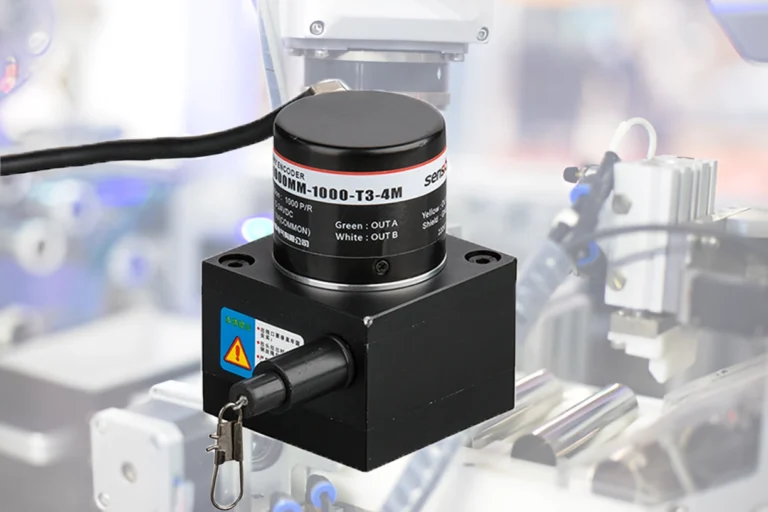
Sensyor Wire Encoder with High Accuracy and Long Range Measurement
Key Features and Benefits of Wire Encoder
Our wire encoder delivers precise linear position measurement with versatility and durability tailored for demanding engineering applications.
| Feature | Benefit | Keywords |
|---|---|---|
| Wide Measuring Ranges | Suitable for short and long stroke applications up to several meters | draw wire encoder, cable extension encoder |
| Encoder Options | Choice of incremental or absolute outputs for flexible integration | incremental draw wire encoder, absolute draw wire encoder |
| High Linearity & Resolution | Ensures accurate, repeatable position readings critical for control systems | linear draw wire transducer, wire displacement sensor |
| Robust Construction | Heavy-duty housing with IP65/IP67 protection ratings suitable for harsh environments | string potentiometer, cable actuated position sensor |
| Shock & Vibration Resistance | Maintains stable performance in mobile machinery and industrial automation | draw wire sensor, string encoder |
| Output Integration Options | Supports analog, digital, and custom protocols for seamless OEM use | string pot position sensor, cable pull encoder |
| Compact Design | Space-saving footprint for easy mounting in tight installations | ropelength transducer, linear position string potentiometer |
These core strengths make our wire encoder ideal for engineers and OEM designers seeking reliable, precise linear measurement solutions in diverse applications.

How It Works: Wire Encoder Operating Principle
A wire encoder, also known as a draw wire encoder or cable extension encoder, measures linear position by winding and unwinding a thin cable attached to a moving object. The core of its operation relies on a spring-loaded drum that automatically retracts the cable, maintaining tension and ensuring smooth motion.
As the cable extends or retracts, it turns the drum connected to the encoder. This rotation generates electrical signals corresponding to the length of the cable pulled. These signals are processed into accurate position data, providing reliable feedback for a variety of applications.
The encoder outputs can be incremental or absolute, depending on the model, allowing easy integration into control systems. This mechanism makes the wire displacement sensor an efficient and precise choice for capturing linear movement in compact spaces. For more details on rotary encoder technology, check out our guide to the GLT8030B rotary encoder and the GLS58B02 rotary encoder.
Product Specifications of Wire Encoder
Here’s a quick rundown of the key specs for our wire encoder (also called draw wire encoder or cable extension linear encoder):
| Feature | Details |
|---|---|
| Measuring Range | From 0.1 m up to 100 m, suitable for short to long moves |
| Accuracy & Repeatability | Typical accuracy ±0.1% full scale, excellent repeatability for precise positioning |
| Output Types | Incremental or absolute signals; options include analog voltage, voltage pulses, and RS485 |
| Cable Specifications | Stainless steel or nylon-coated cables, diameter approx. 1.2 mm, high tensile strength |
| Operating Conditions | Temperature range -20°C to +80°C; humidity resistant; sealed against dust and moisture (IP54/IP65 options) |
| Power & Compliance | 5-24 VDC supply typical; CE and RoHS compliant for international use |
| Physical Dimensions | Compact housings from 50 to 120 mm length; lightweight design ideal for mobile and industrial uses |
Our wire encoder’s precision and sturdy build make it perfect for reliable linear position measurement across diverse industries. This tight spec control supports applications needing consistent accuracy and durability in challenging environments.
For rotary encoder options that integrate well with wire encoder setups, check Sensyor’s range of reliable rotary encoders like the GOS25C rotary encoder and GOH38AO1 rotary encoder.
Model Variants and Selection Guide
Sensyor offers a versatile range of wire encoder models designed to meet diverse measurement needs. Whether you require a draw wire encoder for long-range applications or a compact cable extension encoder for tight spaces, Sensyor’s lineup covers it all. Models differ by measuring range, output type, protection rating, and environmental suitability.
Sensyor Series Overview
- Standard Draw Wire Encoders: Ideal for general-purpose linear position sensing with high durability.
- High-Resolution Variants: Offer superior accuracy and fine resolution for precision tasks.
- Industrial-Grade Models: Built with robust housings and IP ratings to withstand harsh conditions.
- Compact Versions: Space-saving designs for medical devices or automation equipment.
Selection Criteria
When choosing the right wire encoder, consider these key factors:
- Measuring Range: Match the cable length and measurement span to your application needs.
- Operating Environment: Select models with appropriate protection ratings for dust, moisture, shock, or vibration.
- Output Signal: Choose between incremental or absolute draw wire encoders, and verify compatibility with your control system.
- Application Requirements: Consider mechanical mounting constraints, electrical integration, and environmental challenges like temperature extremes or exposure to contaminants.
For precise applications requiring specific output protocols or higher resilience, explore options tailored to your scenario within the Sensyor family.
Learn more about corresponding encoder options with our detailed rotary encoder and magnetic rotary encoder guides to complement your selection process.
Applications of Wire Encoder
Wire encoders, also known as draw wire sensors or string potentiometers, are versatile tools used across many industries. Their ability to provide precise linear position measurements makes them ideal for:
- Mobile Machinery: Monitoring boom or arm positions in construction vehicles and agricultural equipment.
- Hydraulic Feedback: Measuring cylinder extension in hydraulic systems for accurate control.
- Industrial Automation: Tracking movement in automated assembly lines or robotic arms with high reliability.
- Material Handling: Position sensing in conveyor belts, cranes, and hoists for efficient load management.
- Testing Equipment: Recording displacement and motion in durability or performance tests.
- Elevator & Stage Positioning: Ensuring smooth, safe travel with precise position feedback.
- Medical Devices: Providing accurate linear position data in equipment like patient lifts or rehabilitation machines.
These linear draw wire transducers excel when you need robust, compact, and reliable position sensing solutions, especially in demanding environments. To understand their role better in automated systems, check out our guide on incremental rotary encoder applications in industrial automation. This complements wire encoder usage by highlighting how incremental signals support precision control.
Whether you need a string pot position sensor or a cable pull encoder, wire encoders fit seamlessly across various applications requiring dependable motion feedback.
Installation and Mounting of Wire Encoders
Proper installation and mounting of your wire encoder are essential for accurate and reliable measurements. Here’s what to keep in mind:
Mounting Methods
- Use sturdy brackets or mounting plates designed for draw wire encoders to ensure stable positioning.
- Select a mount location that allows easy cable extension and retraction without obstruction.
Cable Alignment and Pulley Routing
- Keep the cable path straight and aligned with the measurement direction to avoid cable wear or deviation.
- Use pulleys if needed to guide the cable smoothly, reducing friction and extending cable life.
- Make sure the cable retracts under proper tension to prevent slack or snagging.
Electrical Connections
- Follow precise wiring guidelines matching the cable extension encoder’s output type (incremental or absolute).
- Use shielded cables to minimize electrical noise interference and ensure signal integrity.
- Secure connections firmly and verify grounding to prevent signal loss.
Measurement Error Minimization Tips
- Avoid cable bends tighter than the encoder’s minimum bending radius to prevent accuracy loss and damage.
- Ensure the cable is fully retracted during installation to reset the zero position correctly.
- Regularly check for cable wear and replace if damaged to maintain consistent performance.
- Calibrate the wire displacement sensor after installation to fine-tune measurement accuracy.
By following these installation tips, you’ll get the most from your cable actuated position sensor, enhancing both lifespan and precision. For rotary encoder integration or advanced mounting accessories, you might explore options like our GOS58FO4 rotary encoder for seamless output integration.
Technical Advantages Over Alternatives
Wire encoders, like draw wire encoders, offer distinct benefits when compared to other position sensing technologies such as LVDT, magnetostrictive, ultrasonic, and laser sensors. Here’s a quick look at how they stack up:
| Feature | Wire Encoder | LVDT | Magnetostrictive | Ultrasonic | Laser Sensors |
|---|---|---|---|---|---|
| Installation Ease | Simple mounting, flexible cable routing | Requires fixed coil assembly | Complex installation | Requires clear acoustic path | Precise alignment needed |
| Measuring Range | Wide, from millimeters to several meters | Limited by coil size | Moderate to long | Moderate | Long, but sensitive to dust/fog |
| Cost Efficiency | Generally low to moderate | Moderate to high | High | Moderate to high | High |
| Robustness | Durable with shock and vibration resistance | Sensitive to mechanical shocks | Good, but sensitive to magnetic interference | Affected by environmental noise | Sensitive to environmental factors |
| Resolution & Accuracy | High linearity and resolution | High but limited range | High and stable | Moderate | Very high |
Why Choose Wire Encoders?
- Installation flexibility: The spring-loaded wire can be routed easily around obstacles, unlike rigid sensors.
- Cost-effective: Ideal for long-range measurements without expensive setups.
- Durability: Robust construction handles industrial environments better than many optical or ultrasonic devices.
- Versatile output: Compatible with multiple output protocols for seamless integration.
If you’re deciding between options, the straightforward installation and range benefits of wire encoders often provide a better balance of performance and cost—especially for applications requiring long stroke length and reliable, repeatable measurements. To explore mounting solutions that maximize these benefits, check out our XT Series Spring Bracket.
Customization Options for Wire Encoders
Our wire encoders offer flexible customization to meet various application needs. Whether you need a draw wire encoder with specific features or particular output requirements, we can tailor the solution for you.
Customizable Features
| Aspect | Options Available |
|---|---|
| Cable Length & Material | Different cable lengths and durable cable materials available for diverse environments and ranges |
| Encoder Resolution | From standard to high resolutions including incremental and absolute draw wire encoders for precision |
| Output Protocols | Choose from analog, digital, or specialty protocols to integrate easily with your system |
| Protection & Certifications | Options for IP ratings, shock/vibration resistance, and certifications for harsh or specialized environments |
This flexibility ensures your wire displacement sensor perfectly fits the space, operational requirements, and performance criteria you need. For advanced encoder output customization, check our guide on incremental encoders customization.
By selecting the right cable material, resolution, and output type, you get a reliable string potentiometer position encoder that adapts to your specific industrial, mobile, or medical application without compromises.
Downloads and Resources for Wire Encoder
Access essential resources to get the most from your wire encoder. We provide detailed datasheets with full technical specs to help you choose the right model. Our 3D CAD models offer precise dimensions for easy integration into your designs. Need help with setup? Download comprehensive installation manuals and wiring diagrams to streamline your assembly process.
For configuration, our user-friendly software tools make it simple to customize output settings and optimize performance. Whether you’re working with a draw wire sensor or a cable extension encoder, these resources ensure smooth installation and reliable operation.
Explore these materials to support your project from planning through maintenance, and contact us if you need additional help or tailored documentation.
Why Choose Sensyor Wire Encoders
Choosing Sensyor for your wire encoder needs means opting for trusted reliability and precision. Our draw wire displacement sensors are built to perform consistently in demanding environments, ensuring accurate position feedback every time.
| Feature | Benefit |
|---|---|
| Reliability | Durable build with stable output under shock and vibration |
| Competitive Pricing | Cost-effective solutions without compromising quality |
| Fast Lead Times | Quick delivery to keep your projects on schedule |
| Engineering Support | Expert help for selecting and integrating the right encoder |
| Precision Commitment | High linearity and resolution for accurate measurements |
Whether you need an incremental draw wire encoder or an absolute cable extension linear encoder, Sensyor’s focus is on delivering measurable value, backed by solid engineering and support. Learn how to choose the right encoders for your project to make the best decision for your application.
Get Your Wire Encoder Quote Today
Ready to improve your measurement accuracy with our reliable wire encoders? Request a custom quote tailored to your exact needs by reaching out to our sales team. For quick responses, use our live chat to discuss your application and get expert advice right away.
Need detailed info? Download datasheets instantly or contact us directly for personalized support. Our team is here to help with everything from selecting the right cable extension encoder to answering technical questions.
Contact options:
- Request a quote for a draw wire sensor or string potentiometer
- Access datasheets and product specifications
- Connect via live chat for real-time assistance
Take the next step toward precise position sensing—get in touch with Sensyor today.
Related Products and FAQ
Looking for accessories for your wire encoder? We offer a range of compatible items like cable guides, pulleys, and mounting brackets to help you get the most out of your draw wire sensor system.
Here are some quick answers to common questions about our cable extension encoders and string potentiometers:
- Cable lifespan: Our wire displacement sensors use durable materials that typically last millions of cycles, but regular inspections prevent unexpected wear.
- Calibration: Draw wire encoders maintain accuracy with simple, periodic calibration. We provide easy-to-follow guides.
- Troubleshooting: For signal inconsistencies, check cable routing and connector integrity. Our resources include wiring diagrams and manuals for quick fixes.
- Speed and acceleration limits: Each model supports specific maximum speeds and acceleration rates—exceeding these can affect measurement accuracy or damage the sensor.
If you want to explore more products or need detailed specs, our rotary encoder options like the GLT5812B rotary encoder or the GOS58FO3 rotary encoder are great complements to wire encoders for various applications.
Feel free to reach out if you need help selecting accessories or have other questions about your cable actuated position sensor setup.